
IT Project Management Consultant: Master 2025 Control
Why IT Project Failures Are Costing Organizations Millions

An IT project management consultant is an external expert who provides specialized guidance to plan, execute, and deliver technology projects successfully. They act as strategic advisors, aligning IT initiatives with business goals and providing objective, unbiased perspectives. As process specialists, they implement proven methodologies (Agile, Waterfall, hybrid) and identify project risks early to ensure projects meet objectives within scope, budget, and timeline.
The statistics tell a sobering story. Most IT projects struggle with budget overruns, missed deadlines, and scope creep. Research shows that organizations working with skilled consultants see 1.5–2.5x reduced schedule and budget deviations, up to 20% faster development cycles, and 96–99% stakeholder satisfaction rates.
Many CIOs are caught between ambitious digital change goals and the harsh reality of failed implementations. The complexity of modern IT environments—from cloud migrations to cybersecurity upgrades—demands specialized expertise that most internal teams lack.
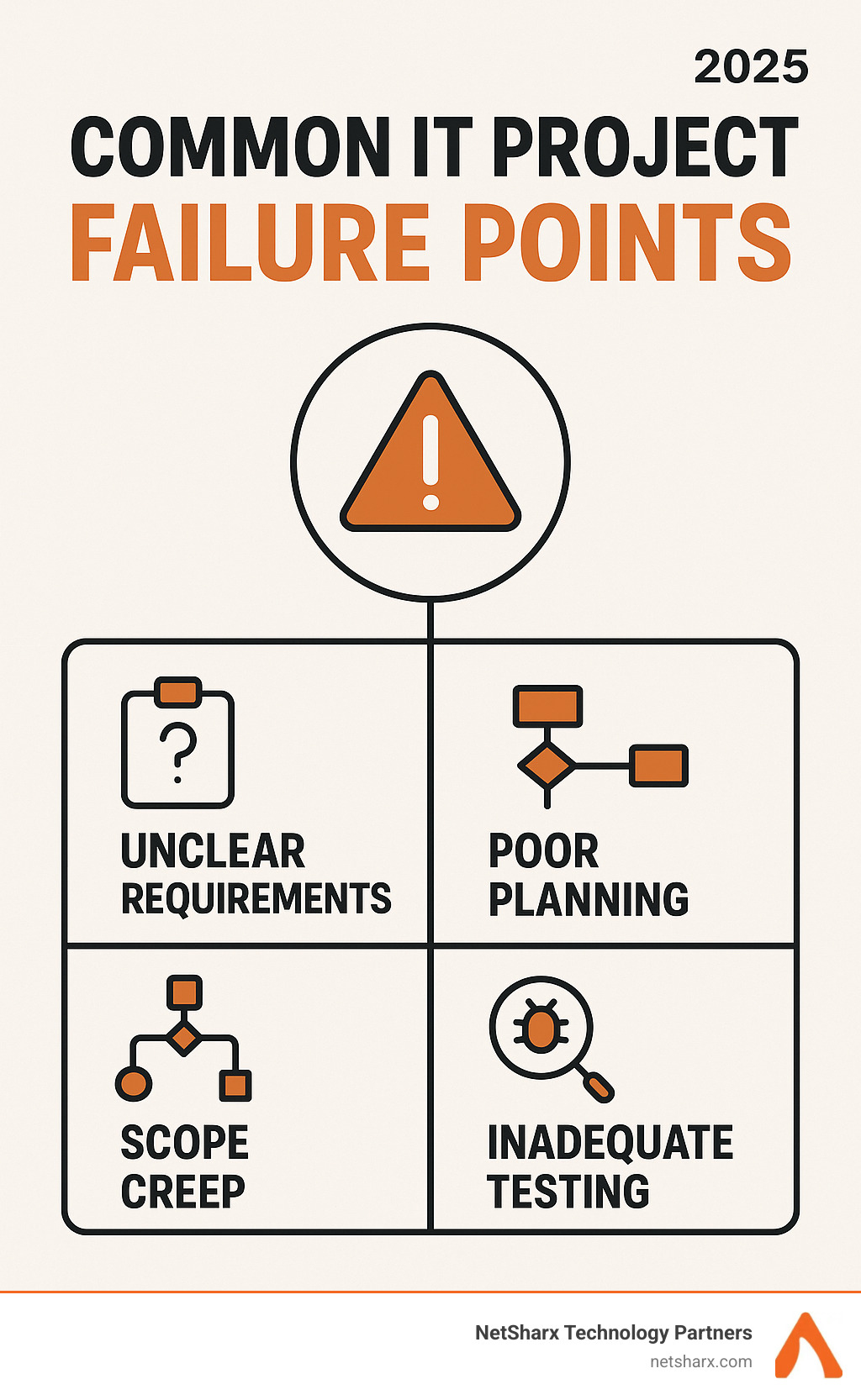
This guide breaks down how to leverage IT project management consultants to transform your technology initiatives from costly gambles into strategic assets.
I’m Ryan Carter, founder and CEO of NetSharx Technology Partners. With over two decades of experience helping enterprises steer complex technology changes, I’ve seen how the right consultant can mean the difference between project chaos and completion.
It project management consultant terms you need:
What is an IT Project Management Consultant? (And What They Are Not)

When an ambitious project like a cloud migration goes over budget and behind schedule, an IT project management consultant can be a lifeline. They are not just temporary staff; they are strategic advisors who bring an external, objective perspective to your technology initiatives. While an internal team may be too close to a problem, a consultant provides clarity, focusing on process optimization and governance to ensure projects are done right.
Their unbiased viewpoint is invaluable. Unconcerned with office politics, a consultant’s sole focus is delivering outcomes that align with business goals. This is critical when navigating complex Digital Change Best Practices or adopting new technologies with specialized AI Consultancy Services.
The Core Role: A Strategic IT Advisor
An IT project management consultant provides specialized knowledge that transforms how your organization approaches technology. As methodology experts, they determine whether Agile, Waterfall, or a hybrid approach is best suited for an initiative. Their primary focus is on business goal alignment, ensuring that technology projects deliver tangible business value, not just technical outputs.
Consultants excel at risk identification, spotting potential issues like scope creep or unrealistic timelines before they become critical. They are also skilled at achieving stakeholder alignment, uniting executives, IT teams, and end-users around a common vision.
Consultant vs. Contractor: A Critical Distinction
Many organizations confuse consultants with contractors, a costly mistake. A consultant provides strategic advice and process improvement, aiming to build your organization’s long-term capabilities. A contractor is a temporary employee who fills a specific role and handles day-to-day tasks.
| Feature | IT Project Management Consultant | IT Project Management Contractor |
|---|---|---|
| Role | Advisor, Strategist, Process Expert | Executor, Interim Manager |
| Responsibility | Providing expert advice, identifying inefficiencies, designing frameworks | Managing daily project tasks, overseeing execution, delivering components |
| Engagement Goal | Improve organizational project management maturity | Fill a specific project management role |
| Deliverables | Strategic plans, process documentation, risk assessments | Project plans, status reports, completed phases |
In short, hire a contractor to manage a specific project’s execution. Hire a consultant to understand why projects are failing and to build a framework for future success.
The “IT” Specialization: Beyond General Project Management
IT projects have unique complexities that require specialized knowledge. An IT project management consultant understands the software development lifecycle (SDLC) and is fluent in Agile & DevOps environments, where continuous integration and deployment are standard.
They integrate cybersecurity protocols into every project phase, ensuring security is a core component, not an afterthought. They have experience navigating the challenges of cloud infrastructure projects, system integration, and complex data migration, where the risk of data loss or business disruption is high. For regulated industries, an IT Compliance Consultant ensures projects meet all necessary standards.
The Core Services: What an IT Project Management Consultant Delivers

An IT project management consultant is a comprehensive partner who guides your team through every phase of a technology initiative. They bring a toolkit of services designed to turn technology chaos into organized success, whether you’re launching a new system, migrating to the cloud, or rescuing a failing project. Their value lies not just in managing tasks, but in establishing the frameworks and governance that enable repeatable success.
Strategic Planning and Project Initiation
Every successful IT project begins with a solid foundation, and this is where a consultant’s impact is most profound. They move beyond vague goals to establish a formal project charter, a foundational document that defines objectives, stakeholders, scope, and success metrics. A consultant starts with thorough feasibility studies to assess your infrastructure, team capabilities, and whether the timeline and budget are realistic. They conduct detailed stakeholder mapping and analysis to identify key influencers, potential detractors, and communication needs, ensuring alignment from the outset.
They assist with business case development to articulate the project’s value in clear financial terms (ROI, NPV, IRR) and define clear scope boundaries using techniques like Work Breakdown Structures (WBS). Consultants bring experience from hundreds of similar projects to create accurate budget and resource estimations, avoiding the common pitfall of optimistic planning that leads to failure. A crucial step is methodology selection, where they help you strategically choose between Agile, Waterfall, or a hybrid approach based on your project’s specific risks, requirements stability, and organizational culture. For cloud initiatives, their expertise in Cloud Migration Best Practices ensures a proven roadmap from the start.
Project Oversight, Control, and Execution
Once a project is running, a consultant acts as its guardian, implementing the governance structures that prevent deviation. They establish meaningful Key Performance Indicators (KPIs) for performance monitoring that go beyond simple status reports, focusing on metrics like Earned Value Management (EVM) to provide an objective measure of progress. They implement formal project controls, including a robust change management process governed by a Change Control Board (CCB) to handle shifting requirements gracefully without derailing the project.
Quality assurance frameworks are integrated throughout the project lifecycle to catch defects early when they are less expensive to fix. With extensive experience, consultants excel at risk mitigation. This involves creating and maintaining a detailed Risk Register, identifying warning signs, quantifying their potential impact, and developing proactive contingency plans before problems escalate. They establish clear stakeholder communication rhythms—such as weekly progress dashboards and monthly steering committee reviews—to keep everyone informed and aligned. This structured communication is especially critical during complex transitions like those detailed in our Cloud Migration Project Management guide.
Specialized Consulting Engagements
Sometimes, standard project management isn’t enough. For projects in crisis or when building new organizational capabilities, consultants offer specialized services that create lasting value.
Project recovery and turnaround is a critical service for initiatives plagued by schedule delays, budget overruns, and low team morale. A consultant performs a rapid but comprehensive project diagnosis to identify root causes—be it technical debt, undefined scope, or poor leadership—and develops a targeted, actionable recovery plan.
In a more proactive capacity, consultants provide team coaching and mentoring to build your internal team’s skills in areas like Agile estimation, risk management, and stakeholder communication. For lasting change, they can lead a PMO implementation, creating a Project Management Office to provide the standards, governance, and tools for consistent project success across the entire organization. This often involves defining the PMO’s charter (supportive, controlling, or directive), establishing standardized templates, and implementing project portfolio management (PPM) tools. Aligning these improvements with security is also key, which is where a Cybersecurity Maturity Assessment can ensure your project management practices are robust and secure.
When to Hire an IT Project Management Consultant

Recognizing when you need specialized help is critical to project success. Engaging an IT project management consultant early provides the greatest opportunity to influence a positive outcome. Organizations that wait until a crisis is already underway limit their options and often pay a premium for emergency intervention. The most value is found in three common scenarios where a consultant’s expertise is not a luxury, but a necessity.
Scenario 1: Launching Complex, High-Stakes Projects
When your organization undertakes large-scale system implementations like an ERP or CRM rollout, the stakes are enormous. These projects form the technological backbone of your business and touch nearly every department. Similarly, initiatives like comprehensive Cloud Migration Services, a complete data center overhaul, developing a new software-as-a-service (SaaS) product, or major digital change initiatives carry significant financial and operational risk.
These projects involve orchestrating technology stack evaluations, managing multiple vendors with competing priorities, and coordinating cross-functional teams that may have never worked together before. The margin for error is slim, and a single misstep in the planning phase can cascade into millions in cost overruns. An IT project management consultant provides a strategic advantage by applying proven methodology selection and establishing strong governance, risk management, and communication plans from day one. They ensure the initial business case is sound, the scope is rigorously defined, and the resource plan is realistic, saving months of rework and significant budget.
Scenario 2: Rescuing a Failing Project
The warning signs of a failing project are often clear: consistent schedule delays, spiraling budget overruns, and uncontrolled scope creep. However, more subtle red flags include a pervasive sense of “meeting fatigue,” a lack of clear decision-making authority, poor team morale, and “watermelon reporting” where status reports are green on the outside but everyone knows the project is red on the inside. When stakeholders start losing confidence and a blame culture emerges, intervention is essential.
Failing projects rarely fix themselves. An IT project management consultant specializing in project recovery and turnaround provides an immediate, objective analysis to diagnose the root causes. Their diagnostic process is swift and thorough, involving a review of all project artifacts (charter, plans, risk logs), interviews with key stakeholders from the executive level to the development team, and an analysis of financial and progress data. From there, they implement decisive corrective actions—such as re-baselining the schedule, de-scoping non-essential features, or restructuring the project team—to get the project back on track. This intervention can be the difference between a total loss and a successful outcome.
Scenario 3: Bridging a Critical Expertise or Resource Gap
No internal IT team can be an expert in everything. An IT project management consultant can strategically fill critical gaps in knowledge or leadership. This is particularly valuable when your team lacks specific methodology experience, such as scaling Agile using a framework like SAFe or implementing complex DevSecOps pipelines. They can also serve as an objective leader for a politically sensitive project, navigating departmental silos and conflicting priorities without being tied to internal politics. Furthermore, they can provide crucial temporary leadership during a transition, such as when a key project director departs unexpectedly.
Consultants are often brought in to augment an over-stretched internal team, providing immediate, high-impact expertise without the long-term commitment and overhead of a new hire. They can also assess and develop internal capabilities, mentoring your staff in project management best practices. In this role, they don’t just fill a gap—they transfer knowledge by co-creating processes, templates, and governance standards, strengthening your team for future challenges. If your team lacks the bandwidth or specific skills for a project involving complex regulatory requirements like HIPAA or GDPR, an IT Implementation Consultant can provide the necessary focused support.
The Tangible Benefits: Measuring the ROI of an Expert IT Project Management Consultant
Bringing in an IT project management consultant is not an expense; it’s an investment with a clear, measurable return. The numbers are impressive, showing dramatic improvements that directly impact the bottom line. But the benefits extend beyond financials to create a more effective and confident organization.

Financial and Operational Gains
Organizations working with an IT project management consultant see significant financial and operational improvements. Key metrics include:
- 1.5 to 2.5 times fewer schedule and budget deviations, leading to predictable outcomes.
- Up to 20% faster requirements gathering and development cycles, thanks to proven frameworks that eliminate rework.
Proactive risk management prevents costly errors before they happen, saving organizations from expensive fixes and project restarts. Furthermore, improved resource allocation ensures that team members are focused on high-value tasks, increasing productivity and reducing waste.
Strategic and Team-Oriented Advantages
The human and strategic benefits are just as impactful. Project stakeholder satisfaction rates of 96 to 99% reflect a smoother, more positive project experience for everyone involved. This leads to team motivation and productivity increases of 20 to 50%, as clear goals and confidence in the process energize employees.
Improved communication and transparency eliminate confusion and surprises, while ensuring IT projects align with business strategy. This transforms the IT department from a cost center into a driver of growth and competitive advantage.
How They Address Common Project Challenges
An expert consultant is equipped to handle familiar project challenges. They use clear change control processes for scope creep management and apply financial discipline for budget overrun controls. Realistic planning and agile adjustments provide schedule delay mitigation. By integrating quality assurance processes and resolving resource conflicts, they ensure projects run smoothly. This outside perspective is invaluable for spotting blind spots internal teams might miss, as discussed in our guide on how a Trusted Technology Partner Can Guide You to the Right Cloud Technology Solutions.
The Anatomy of an Elite IT Project Management Consultant

What separates a good IT project management consultant from an elite one? It’s a unique combination of deep soft skills, broad technical depth, and proven, verifiable credentials. While many can manage a schedule, an elite consultant acts as a trusted advisor who can steer ambiguity, steer through complex challenges, and guide your organization’s most important technology initiatives to success.
Essential Qualities and Soft Skills
The most successful consultants share core qualities that make them effective leaders. They demonstrate leadership that inspires confidence in a project team and earns the trust of executive sponsors. Their credibility is built not just on past successes, but on their transparent and honest approach to challenges. Exceptional communication is paramount; this means being able to translate complex technical risks into clear business impacts for a board meeting in the morning, and then facilitating a detailed technical discussion with an engineering team in the afternoon. They excel at stakeholder management, building consensus among diverse groups and navigating corporate politics with strong negotiation and influence skills to align conflicting interests toward a common goal.
A problem-solving mindset allows them to deconstruct complex issues into manageable components, while adaptability enables them to pivot when a chosen strategy is no longer viable. Finally, strong business acumen ensures that all technical decisions, project priorities, and risk mitigation efforts are directly aligned with broader organizational goals and financial objectives. They are trusted partners who can effectively manage client relationships and expectations.
Core Technical Skills and Methodologies
Technical expertise is non-negotiable. An elite IT project management consultant masters a comprehensive toolkit of hard skills, including:
- Risk analysis and management to not only identify but also quantify risks (e.g., using Monte Carlo simulations) and develop robust mitigation and contingency plans.
- Budgeting and financial forecasting to manage project costs carefully, track variances, and provide accurate forecasts to prevent financial surprises.
- Scheduling and critical path analysis to identify dependencies, optimize resource allocation, and understand the true drivers of the project timeline.
- Proficiency in PM software like Jira, Asana, Microsoft Project, or enterprise-grade PPM tools like ServiceNow to manage work and provide transparent reporting.
Their deep understanding of methodologies is critical. They know when to apply Agile, Scrum, or Kanban for projects with evolving requirements that benefit from flexibility and iterative development. They also know when to use structured, predictive approaches like Waterfall or PRINCE2 for projects with fixed scopes and high regulatory problems. Most importantly, they are experts at creating Hybrid models that blend elements to fit a project’s unique context. For example, they might use a Waterfall approach for the initial infrastructure setup and hardware procurement phases of a project, then switch to Agile sprints for the software development and user-facing feature delivery.
Must-Have Certifications and Credentials
Certifications validate a consultant’s mastery of standardized best practices and demonstrate a commitment to professional excellence. While experience is king, these credentials provide a baseline of trust and knowledge.
- PMP (Project Management Professional): The global gold standard from the Project Management Institute (PMI), validating competence to lead and direct projects and teams across various methodologies.
- PRINCE2 (PRojects IN Controlled Environments): Demonstrates expertise in a structured, process-driven approach that is highly valued in Europe and for large, complex government and corporate initiatives.
- CSM (Certified ScrumMaster) / PSM (Professional Scrum Master): Shows mastery of the Scrum framework, its roles, events, and artifacts, which is essential for modern software development and Agile changes.
- ITIL (Information Technology Infrastructure Library): Validates a deep understanding of IT service management (ITSM), crucial for ensuring that new technology projects are smoothly integrated with ongoing IT operations.
- PMI-ACP (PMI Agile Certified Practitioner): Confirms knowledge across a range of Agile methodologies (including Scrum, Kanban, Lean, XP), signaling a more versatile Agile skillset beyond just one framework.
These credentials, combined with a proven track record of real-world experience, are the hallmark of a consultant who can deliver tangible, measurable business results.
Conclusion: Changing Your IT Projects from a Liability to an Asset
The statistics don’t lie. When IT projects fail, they don’t just waste money—they can derail entire business strategies and shake stakeholder confidence. But here’s what we’ve finded through decades of working with organizations just like yours: the right IT project management consultant doesn’t just fix problems; they prevent them from happening in the first place.
Think about where we started this conversation. Those sobering failure rates, the budget overruns that make CFOs cringe, the missed deadlines that push critical business initiatives into the next fiscal year. Now contrast that with what we’ve shown you throughout this guide: 1.5–2.5x reduced schedule deviations, up to 20% faster development cycles, and 96–99% stakeholder satisfaction rates. That’s not just improvement—that’s change.
An IT project management consultant serves as more than just an external expert. They become your strategic partner, bringing that crucial outside perspective that can see the forest when your internal team is focused on the trees. They’re the ones who spot the early warning signs of scope creep, who know exactly when to pivot methodologies, and who can steer the complex stakeholder dynamics that often make or break technology initiatives.
What makes this investment truly worthwhile is how it changes your organization’s DNA. The best IT project management consultants don’t just deliver successful projects—they leave behind stronger internal teams, better processes, and a culture that views technology change as an opportunity rather than a risk.
At NetSharx Technology Partners, we’ve seen this change happen countless times. Organizations come to us feeling overwhelmed by the complexity of modern IT landscapes—cloud migrations that seem impossibly complex, cybersecurity upgrades that can’t afford to fail, digital changes that need to happen yesterday. We understand that feeling because we’ve been there with hundreds of clients, helping them steer from chaos to completion.
Our role as your trusted technology partner goes beyond just providing IT project management consultant services. We’re your technology broker, offering unbiased guidance across cloud, network, cybersecurity, and communications solutions. We don’t have skin in the game with any particular vendor, which means our recommendations are always based on what’s best for your specific situation. Our extensive provider network ensures you get competitive pricing and custom solutions that actually fit your business needs.
The choice is yours. You can continue treating IT projects as necessary evils—expensive, risky endeavors that you hope will somehow work out. Or you can make the strategic decision to partner with experts who know how to turn technology initiatives into competitive advantages.
Don’t let another project become a cautionary tale in your next board meeting. With the right IT project management consultant and a solid technology foundation, your next IT initiative could be the one that everyone points to as a model of how things should be done.
Ready to make that shift from project chaos to strategic success? Explore our solutions and find how NetSharx Technology Partners can help you build the technology foundation your business deserves.
Real-World Success Stories: How Consultants Salvaged (and Created) Millions in Value
Nothing brings the value of an IT project management consultant to life like seeing the numbers in action. Below are three detailed case studies drawn from NetSharx engagements and public-domain project post-mortems. Each story shows how a consultant’s early intervention, proven methodology, and outside perspective translated into hard ROI.
Case Study 1: Global Retailer Rescues a $42 Million ERP Roll-Out
-
The Challenge: A Fortune 500 retailer planned a two-year SAP S/4HANA implementation touching 17 business units and 180+ upstream systems. Fifteen months in, they were already 38 percent over budget, facing a 12-month slip in go-live, and internal leadership turnover had eroded stakeholder confidence.
-
Consultant’s Approach:
- Deployed a three-week Project Health Diagnostic that interviewed 64 stakeholders, reviewed 2,300 Jira tickets, and mapped 57 integration points.
- Re-baselined scope using Earned Value Management (EVM), trimming non-critical customizations that accounted for 22 percent of development hours.
- Introduced Agile-within-Waterfall: Agile sprints for interface development, waterfall milestones for data conversion and change management.
- Established a daily 15-minute virtual “Leadership Stand-Up” with C-suite sponsors to keep decisions within 24 hours.
-
The Result:
- $11.3 million in cost avoidance by cutting low-value features and renegotiating two vendor contracts.
- Recovered six months of schedule; new phased go-lives went live region-by-region with less than 2 percent defect leakage.
- Post-implementation survey showed 97 percent end-user satisfaction and a 19 percent inventory-turn improvement one quarter after go-live.
Case Study 2: Healthcare Provider Hardens Cybersecurity During EMR Modernization
-
The Challenge: A U.S. healthcare network had to migrate 4.8 TB of patient data to a next-gen Electronic Medical Records (EMR) platform while meeting HIPAA, HITRUST, and state privacy mandates. The internal PM believed the project would pass security audit until an external assessor flagged 147 critical gaps.
-
Consultant’s Approach:
- Assembled a cross-functional risk-triage tiger team (security, legal, DevOps, clinical IT).
- Implemented an NIST 800-53 control matrix mapped directly into Azure DevSecOps pipelines; 31 automated policy gates stopped non-compliant code from merging.
- Ran two tabletop cyber-incident simulations with executives, validating roles, communications, and legal hold processes.
-
The Result:
- Achieved full regulatory sign-off six weeks before the statutory deadline, avoiding $1.2 million in potential fines.
- Cut mean-time-to-detect (MTTD) for security events from 8 hours to 27 minutes post-go-live.
- Clinician feedback cited a 32 percent reduction in login-to-chart lag, illustrating that security and usability are not mutually exclusive.
Case Study 3: FinTech Scale-Up Adopts Scaled Agile and Doubles Release Velocity
-
The Challenge: A venture-backed SaaS provider delivering payment-risk APIs saw feature backlogs balloon and bugs creep into production. With a Series-C funding round pending, leadership feared reputation damage.
-
Consultant’s Approach:
- Conducted a two-day Value-Stream Mapping workshop identifying four approval queues causing 41 percent of lead-time waste.
- Rolled out Scaled Agile Framework (SAFe) Program Increment (PI) Planning across three distributed teams and standardized Definition-of-Done.
- Introduced test-driven development (TDD) and a “fail-fast” culture via sandbox environments and Chaos Engineering drills.
-
The Result:
- Release cadence improved from once every 21 days to twice weekly within two PIs.
- Defect escape rate to production fell by 68 percent.
- Investors cited “process maturity” as a key factor in a successful $75 million Series-C close.
Lessons You Can Apply Tomorrow
- Map Reality Before You Prescribe Fixes – Every turnaround began with a rapid yet comprehensive findy sprint. Resist the temptation to jump straight to solutions.
- Prioritize Ruthlessly Against Business Value – Cutting 22 percent of ERP customizations felt painful, but saved millions and kept critical features.
- Blend Methodologies Intentionally – Hybrids (Agile within Waterfall, SAFe + DevOps) avoided dogma and fit organizational culture.
- Lift Risk Conversations to Executives Daily – 15-minute C-suite stand-ups eliminated decision bottlenecks that previously added weeks of delay.
- Automate Compliance Where Possible – Embedding security gates directly into CI/CD pipelines moved audit from a post-project headache to an everyday activity.
Applied correctly, these takeaways let any organization replicate success without learning the hard (and expensive) way.
Quick-Start Checklist: Engaging an IT Project Management Consultant the Right Way
Use this one-page checklist in your next steering-committee meeting or vendor-selection call. It’s distilled from more than 200 successful consultant engagements.
-
Clarify the Problem Statement (30-Minute Exercise)
- What business pain are we solving?
- Which KPI will tell us the engagement was a win?
-
Define Success Criteria Up Front
- Hard metrics: budget variance less than 5 percent, go-live date, uptime SLA.
- Soft metrics: stakeholder NPS, team morale pulse-scores.
-
Set the Scope for Advice vs. Execution
- Are we buying strategy, hands-on delivery, or both?
- Decide early to avoid consultant “creep” that silently expands invoices.
-
Request Proof of Domain Expertise
- Look for case studies in YOUR industry or tech stack.
- Verify certifications (PMP, SAFe, ITIL) are current.
-
Run a Culture-Fit Interview
- Ask how they’ve handled political landmines.
- Gauge communication style—does it mesh with your leadership team?
-
Negotiate Outcome-Based Pricing
- Tie 10-25 percent of fees to hitting pre-agreed milestones.
- Beware of pure time-and-materials for open-ended advisory work.
-
Institutionalize Knowledge Transfer
- Mandate shadowing or brown-bag sessions so your team levels up.
- Require templates, risk logs, and playbooks as deliverables, not “nice-to-haves.”
-
Schedule Formal Gate Reviews
- Align with corporate governance (e.g., Stage-Gate, PMO tollgates).
- Use red/amber/green dashboards visible company-wide.
-
Plan the Exit Strategy on Day 1
- Define what “Done” means for the consultant.
- Identify which internal role will own each ongoing responsibility.
-
Celebrate and Document Wins
- Publicly recognize both consultant and internal teams.
- Archive lessons-learned in a searchable repository so history doesn’t repeat.
Follow these ten steps and you’ll dramatically raise the odds that your next consultant engagement delivers not just on time and on budget—but with lasting organizational impact.
