
Sase sd wan: Top 5 Powerful Benefits & Key Differences 2025
Why Modern Networks Need Both SD-WAN and SASE Solutions
SASE SD WAN represents the evolution of enterprise networking, where traditional WAN architectures merge with cloud-native security frameworks. Here’s what you need to know:
Key Differences:
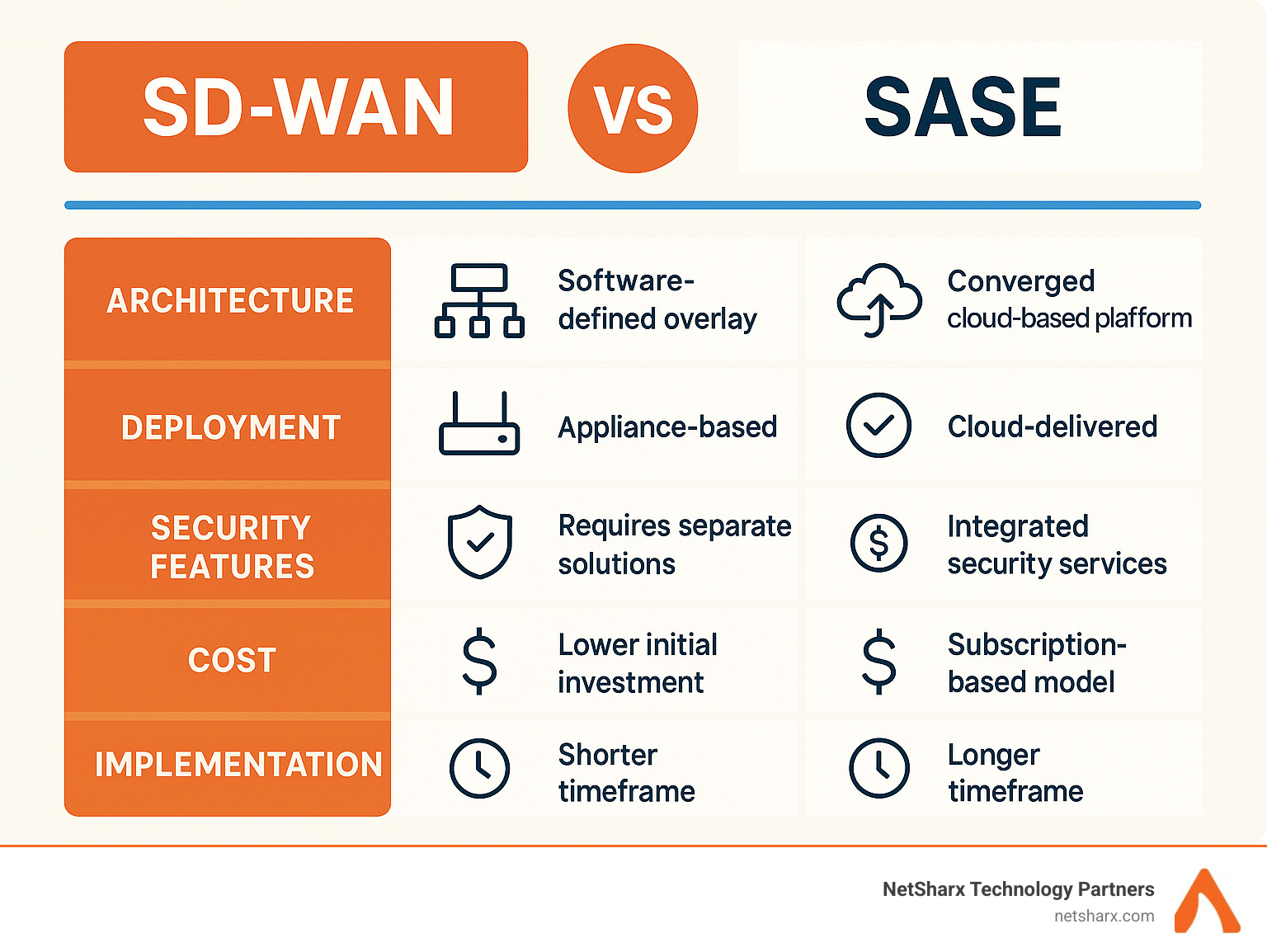
– SD-WAN: Software-defined overlay for connecting branch offices, optimizing traffic across multiple links
– SASE: Combines SD-WAN with cloud-delivered security services (firewall, web gateway, zero trust)
– Deployment: SD-WAN uses appliances; SASE delivers services from global cloud points of presence
– Focus: SD-WAN emphasizes connectivity; SASE prioritizes security integration
The Bottom Line: SASE builds upon SD-WAN’s foundation, adding comprehensive security services that 65% of enterprises expect to adopt according to industry research.
With 92% of enterprises adopting multicloud strategies and 58% suffering security breaches in the past year, the question isn’t whether to modernize your WAN – it’s how to balance connectivity optimization with comprehensive security.
About the Author: I’m Ryan Carter, founder and CEO of NetSharx Technology Partners, where I’ve helped hundreds of organizations migrate from legacy networks to cloud-enabled SASE SD WAN architectures over the past two years.
Sase sd wan vocab to learn:
– sase architecture diagram
– secure access service edge market
– sase in cyber security
Understanding the Building Blocks of Modern WAN
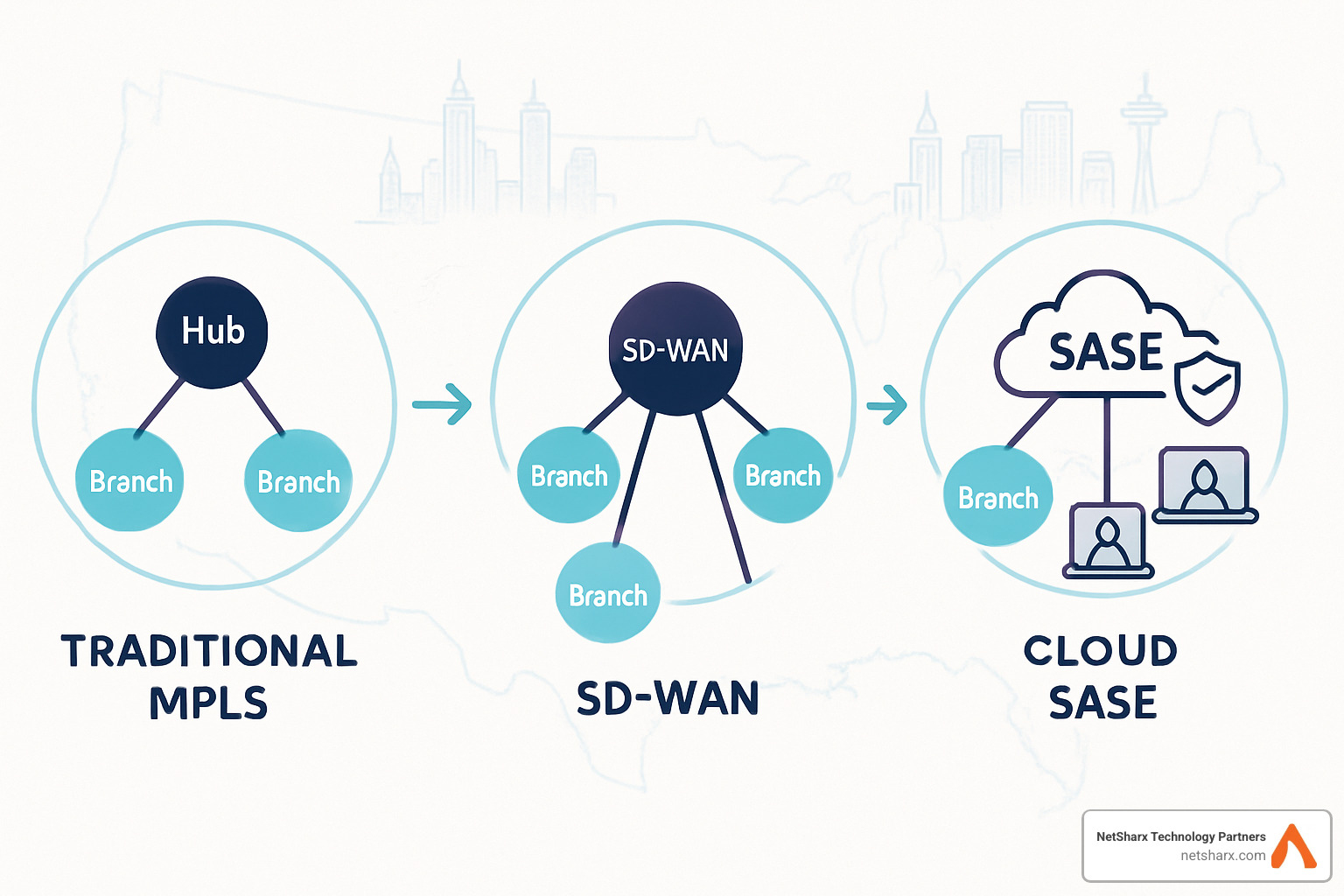
Think of your current network like a city built in the 1990s. Everything revolved around downtown (your data center), with office buildings connected by well-planned highways (MPLS circuits). Today, everyone’s working from distributed locations while applications have moved to the cloud suburbs.
This shift from centralized to distributed everything is exactly why SASE SD WAN technologies emerged. The challenge with traditional WAN architectures is the “trombone-routing problem” – branch office traffic backhauling through corporate data centers before reaching cloud applications.
What Is SD-WAN?
SD-WAN emerged around 2012 when engineers realized there had to be a better way to manage wide area networks. Instead of manually configuring each router, what if you could control everything centrally and use multiple connection types intelligently?
The genius lies in its software-defined overlay approach – creating a smart highway system on top of existing roads. Application-aware routing means your ERP system gets premium MPLS treatment while web browsing uses cheaper broadband. Control plane separation enables centralized policy management across all locations.
Cost savings are real – many organizations see network costs drop by 50% when replacing expensive MPLS circuits with SD-WAN solutions that intelligently use cheaper broadband for appropriate traffic.
Core SD-WAN Components
Centralized Orchestration: The brain of SD-WAN operations, providing single-pane-of-glass management across all locations. Network administrators can push policy changes, monitor performance, and troubleshoot issues from a unified dashboard rather than logging into individual devices.
Edge Appliances: Physical or virtual devices deployed at branch locations that create secure tunnels and implement traffic policies. These appliances continuously monitor link quality, automatically failing over to backup connections when primary links degrade.
Dynamic Path Selection: Real-time traffic steering based on application requirements, link quality, and business policies. Critical applications get priority routing while less important traffic uses cost-effective paths.
Zero-Touch Provisioning: New locations can be operational within hours rather than weeks. Appliances ship pre-configured and automatically establish secure connections to the orchestration platform upon installation.
SD-WAN Security Considerations
While SD-WAN provides encrypted tunnels between locations, security capabilities vary significantly between vendors. Basic implementations offer IPsec encryption and simple firewall rules, but lack advanced threat protection, URL filtering, and intrusion prevention.
Many organizations find they need additional security appliances at each location, potentially negating cost savings and adding management complexity. This realization often drives interest in SASE solutions that integrate comprehensive security from the start.
What Is SASE?
If SD-WAN solved connectivity, SASE tackles the bigger picture. When Gartner coined the term in 2019, they recognized networking and security were converging into a single, cloud-delivered platform.
SASE brings together Firewall as a Service (FWaaS), Secure Web Gateway (SWG), Cloud Access Security Broker (CASB), and Zero Trust Network Access (ZTNA) – traditionally separate appliances now unified.
The global Points of Presence (PoPs) fabric makes SASE different. Instead of backhauling traffic to centralized security appliances, SASE providers maintain hundreds of cloud-based security inspection points worldwide.
SASE Architecture Deep Dive
Cloud-Native Infrastructure: SASE platforms are built from the ground up for cloud delivery, enabling automatic scaling, global deployment, and consistent policy enforcement. This architecture eliminates the hardware refresh cycles and capacity planning challenges of traditional appliance-based security.
Identity-Centric Security: Every user and device gets authenticated and authorized before accessing resources, regardless of location. This zero-trust approach assumes no implicit trust based on network location, requiring verification for every access request.
Converged Service Stack: Instead of managing separate point solutions for firewall, web filtering, DLP, and remote access, SASE provides integrated services with unified policies and reporting. This convergence reduces vendor complexity and eliminates security gaps between solutions.
Global Service Fabric: SASE providers maintain Points of Presence worldwide, ensuring users connect to nearby security inspection points for optimal performance. Traffic gets processed at the network edge rather than backhauled to centralized data centers.
SASE Service Components Explained
Firewall as a Service (FWaaS): Cloud-delivered next-generation firewall capabilities including application control, intrusion prevention, and advanced threat protection. Policies are enforced consistently across all users and locations without managing distributed appliances.
Secure Web Gateway (SWG): URL filtering, malware protection, and data loss prevention for web traffic. Advanced implementations include SSL inspection, cloud application visibility, and real-time threat intelligence integration.
Cloud Access Security Broker (CASB): Visibility and control for cloud applications, including shadow IT findy, data classification, and compliance monitoring. CASB capabilities help organizations understand and secure cloud application usage across their workforce.
Zero Trust Network Access (ZTNA): Application-specific access control that replaces traditional VPN connectivity. Users get access to specific applications rather than broad network segments, reducing attack surface and improving security posture.
According to research on SASE market growth, the technology is experiencing explosive adoption as organizations realize separate point solutions create more complexity than they solve.
sase sd wan Head-to-Head: Similarities and Differences
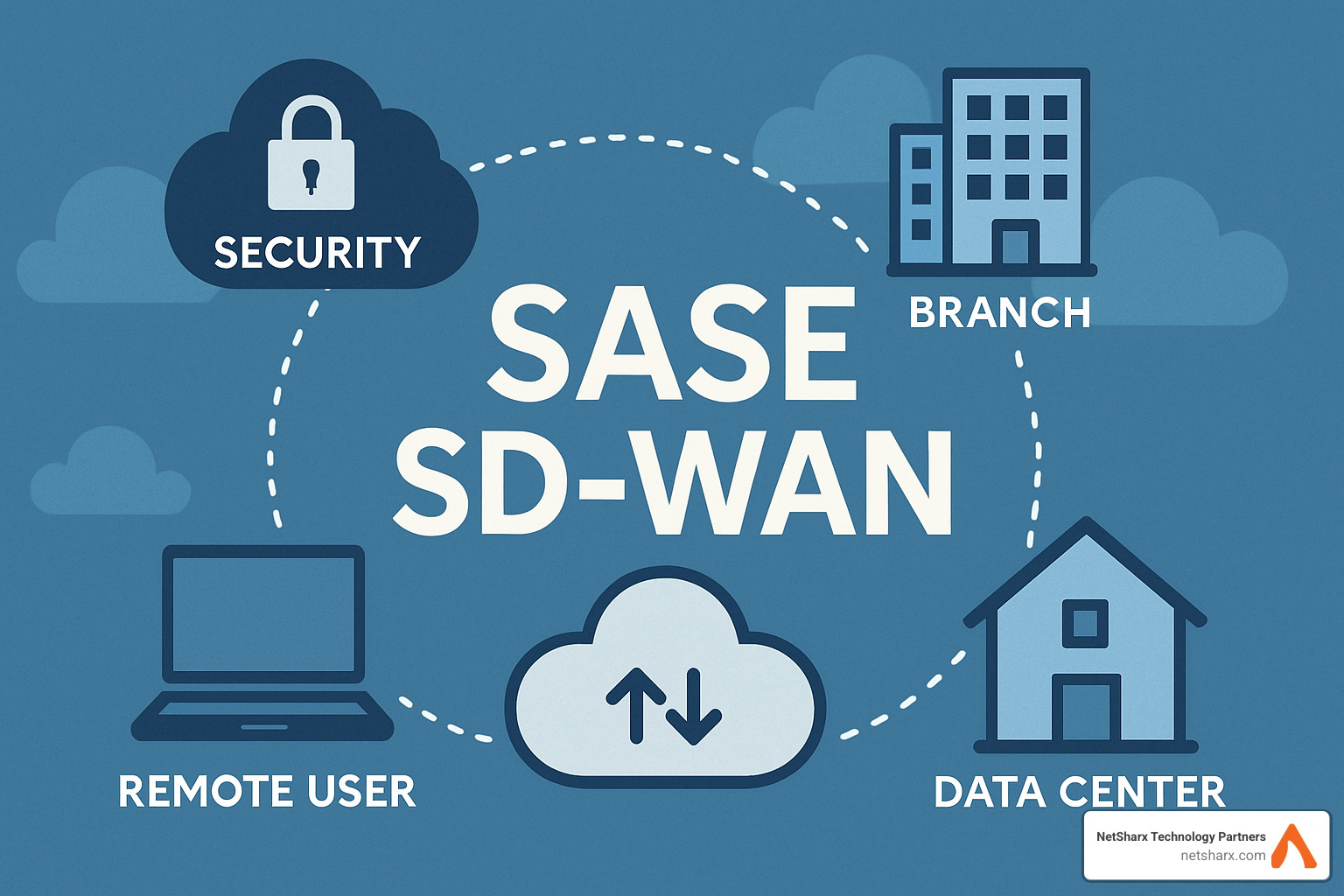
SASE SD WAN isn’t about choosing sides – it’s understanding how these technologies work together. If SD-WAN is smart traffic management, SASE is that system plus comprehensive security checkpoints.
Both share fundamental DNA: virtualized infrastructure, overlay networks, and cloud-based management. But their differences matter for your business.
| Feature | SD-WAN | SASE |
|---|---|---|
| Primary Focus | Network connectivity and optimization | Converged networking and security |
| Deployment Model | Appliances at branch locations | Cloud-delivered services via global PoPs |
| Security Integration | Basic encryption, requires third-party security | Built-in comprehensive security services |
| Remote User Support | Limited, requires VPN for remote access | Native support for remote and mobile users |
| Management Complexity | Separate network and security management | Unified management for networking and security |
Architecture & Deployment Models
SD-WAN’s “Build Your Own” Approach: Install appliances at each location, creating secure tunnels and overlay networks. Works well for predictable branch office connectivity but requires managing distributed hardware.
SASE’s “Cloud-First” Philosophy: Plug into global infrastructure with global PoPs, cloud-native services, and lightweight edge connectivity. Traffic gets processed at the nearest PoP for better performance.
Security Approaches
SD-WAN Security: Provides encryption and basic firewall capabilities but often requires additional security solutions, creating management complexity.
SASE Security: Integrates comprehensive security directly into the network fabric with real-time threat protection, URL filtering, and zero-trust access principles.
Remote & Mobile User Support
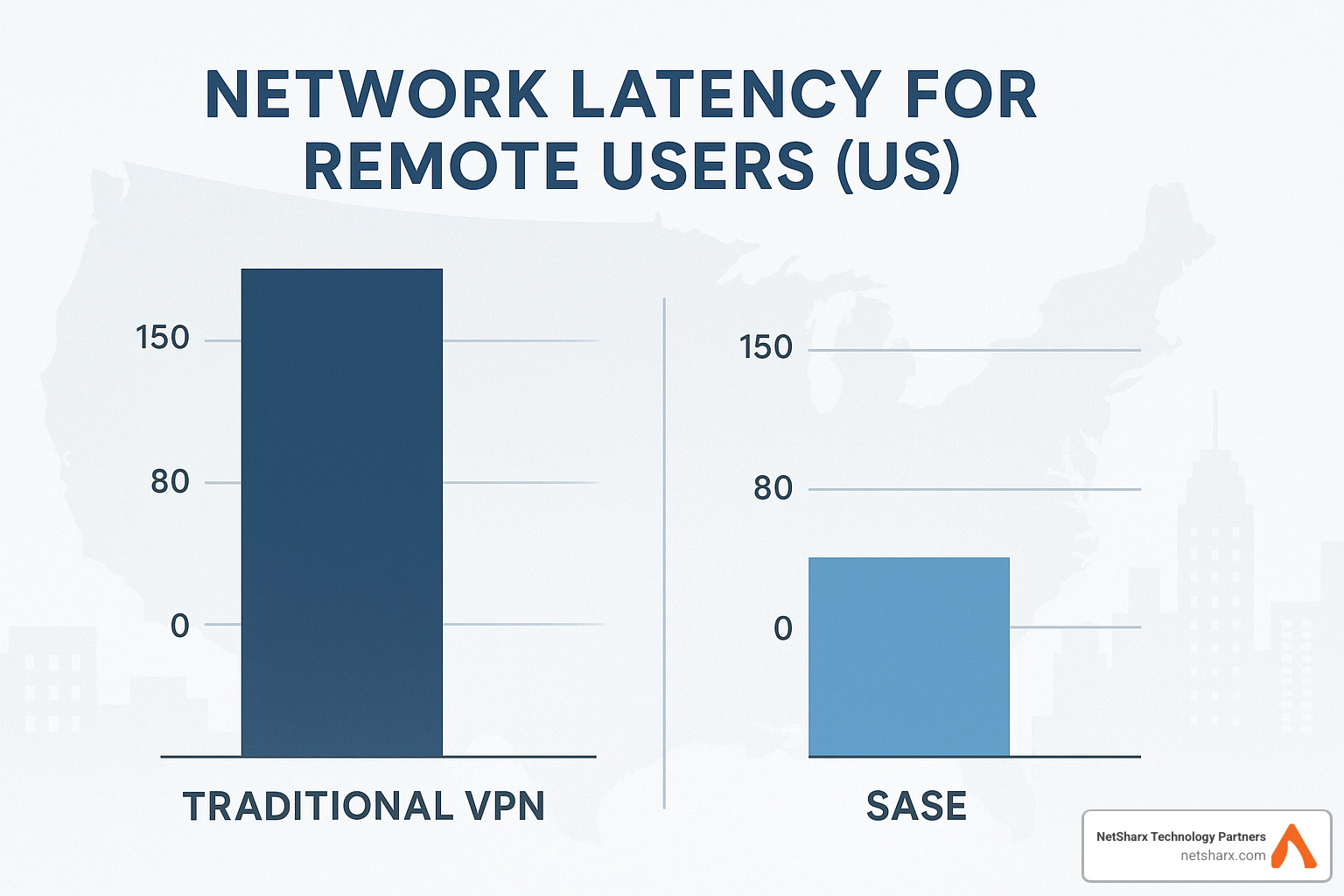
SD-WAN: Designed for branch offices, requires separate VPN infrastructure for remote workers, often creating performance bottlenecks.
SASE: Built for distributed workforces from day one. Remote users connect directly to the nearest PoP, getting consistent performance regardless of location.
Benefits, Limitations, and Real-World Use Cases
SD-WAN infrastructure revenue is growing at 26.5% annually, reaching $7.08 billion by 2025, with 95% of enterprises using or planning SD-WAN implementation. SASE follows similarly, with 65% planning adoption and the market projected to hit $11.29 billion by 2028.
SD-WAN Pros & Cons
Benefits:
– Cost reduction: Up to 50% savings by replacing expensive MPLS with intelligent broadband usage
– Improved agility: New locations operational within days versus 60-90 days for MPLS
– Application performance: Application-aware routing prioritizes critical traffic
– Simplified management: Centralized policy deployment across all locations
Limitations:
– Security gaps: Basic encryption insufficient for comprehensive threat protection
– Implementation complexity: Requires careful traffic policy design and planning
– Internet dependency: Performance relies on underlying broadband quality
SD-WAN Implementation Challenges
Policy Design Complexity: Creating effective application-aware routing policies requires deep understanding of application behavior, business priorities, and network characteristics. Poorly designed policies can actually degrade performance rather than improve it.
Internet Circuit Quality: SD-WAN performance depends heavily on underlying broadband connections. Organizations in areas with limited ISP options may struggle to achieve expected benefits, particularly for real-time applications like voice and video.
Staff Training Requirements: Network teams accustomed to traditional routing protocols need significant training on software-defined networking concepts, centralized orchestration, and application-aware policies.
Vendor Lock-in Concerns: Many SD-WAN solutions use proprietary protocols and management systems, making it difficult to switch vendors or integrate with other networking technologies.
SASE Pros & Cons
Benefits:
– Unified security and networking: Eliminates vendor complexity and security gaps
– Cloud-native scalability: Automatic scaling without hardware installations
– Optimized remote access: Consistent performance for distributed workforces
– Total cost of ownership: Reduces long-term expenses through consolidation
Limitations:
– Market maturity: Still evolving with no single vendor offering complete solutions
– Migration complexity: Requires careful planning to avoid service disruptions
– Performance dependency: Relies on provider PoP coverage in your regions
SASE Adoption Barriers
Vendor Ecosystem Immaturity: While the SASE concept is compelling, no single vendor currently delivers all capabilities at enterprise scale. Organizations often need multiple SASE vendors or hybrid approaches combining SASE with existing solutions.
Skills Gap Challenges: SASE requires expertise spanning networking, security, cloud architecture, and zero-trust principles. Finding professionals with this broad skill set is challenging, leading many organizations to rely heavily on vendor professional services.
Legacy Integration Complexity: Existing security investments, compliance requirements, and operational procedures don’t disappear overnight. SASE implementations must carefully integrate with legacy systems while providing migration paths.
Performance Variability: SASE performance depends on provider PoP locations, internet connectivity quality, and traffic patterns. Organizations with users in remote locations may experience inconsistent performance.
Real-World Use Cases and Success Stories
Manufacturing Company SD-WAN Implementation
A global manufacturing company with 150 locations replaced MPLS with SD-WAN, achieving 45% cost reduction while improving application performance. Key success factors included standardizing on dual-ISP connectivity at each location, implementing application-aware policies for ERP and video conferencing, and using cloud-based management for centralized control.
Challenges included training network staff on new technologies, managing the transition without disrupting production systems, and optimizing policies based on actual application behavior rather than assumptions.
Financial Services SASE Migration
A regional bank implemented SASE to support remote workers while meeting strict compliance requirements. The solution provided consistent security policies for office and remote users, eliminated VPN performance bottlenecks, and simplified compliance reporting through unified logging.
The migration took 18 months, including pilot testing, staff training, and gradual rollout across user groups. Key lessons learned included the importance of user experience testing, the need for comprehensive change management, and the value of maintaining parallel systems during transition.
Healthcare System Hybrid Approach
A healthcare system with 50 locations implemented SD-WAN for site-to-site connectivity while adding SASE services for remote clinicians and administrative staff. This hybrid approach preserved existing security investments while adding cloud-delivered capabilities for distributed users.
The implementation improved telehealth application performance, reduced IT support burden for remote access, and provided better visibility into cloud application usage across the organization.
Choosing SD-WAN, SASE, or Both
SD-WAN makes sense when your primary focus is branch office connectivity and cost optimization, with adequate existing security infrastructure. Organizations with predictable traffic patterns, centralized applications, and traditional office-based workforces often find SD-WAN sufficient for their needs.
SASE becomes compelling for organizations with large remote workforces, cloud-first strategies, or security consolidation priorities. Companies undergoing digital change, expanding internationally, or facing compliance requirements often benefit from SASE’s integrated approach.
Hybrid approaches work well for preserving existing SD-WAN investments while adding SASE capabilities for specific use cases like remote user access. This strategy allows organizations to evolve their infrastructure gradually while maximizing existing investments.
Decision Framework
Assess Current State: Document existing network architecture, security solutions, user distribution, and application portfolio. Understanding your starting point is crucial for making informed decisions about future direction.
Define Requirements: Identify specific business drivers, performance requirements, security needs, and budget constraints. Clear requirements help evaluate solutions objectively rather than being swayed by vendor marketing.
Evaluate Options: Consider pure-play solutions, hybrid approaches, and phased migration strategies. Most organizations benefit from gradual transitions rather than dramatic rip-and-replace implementations.
Plan Implementation: Develop detailed project plans including pilot testing, user training, change management, and rollback procedures. Successful implementations require careful planning and stakeholder buy-in.
Implementation & Management Considerations for sase sd wan
Planning SASE SD WAN deployment requires understanding costs, building the right team, and choosing partners for long-term success.
Cost & Complexity
SD-WAN Economics: The 50% cost reduction comes from replacing MPLS with broadband for non-critical traffic. However, hidden charges like installation fees, professional services, and training can add 30-40% to initial budgets.
SASE Subscription Reality: Per-user pricing sounds simple but escalates quickly. Migration costs include running parallel systems, staff retraining, and potential contract termination fees.
SD-WAN front-loads complexity with challenging initial design but stable operation. SASE distributes complexity over time with simpler deployment but ongoing cloud service management.
Skills & Staffing
SD-WAN Skills: Network engineers need application-aware routing expertise and security integration knowledge. The shift from hardware-centric to software-defined thinking challenges traditional approaches.
SASE Skills: Requires broader expertise combining networking, security, cloud architecture, and zero-trust principles. Finding professionals with all these skills is challenging, leading to significant cross-training investments.
Vendor & Partner Selection
Key Evaluation Criteria:
– Global Infrastructure: PoP density and quality in your markets
– SLA Commitments: Understanding uptime guarantees and remediation procedures
– Integration Capabilities: API availability and proven integration track records
– Vendor Roadmap: Development alignment with your strategic direction
At NetSharx Technology Partners, our agnostic engineering approach ensures clients get solutions custom to specific needs rather than single-vendor limitations. Our extensive provider network enables competitive pricing while lifecycle support helps with ongoing optimization.
For comprehensive evaluation, our Network Connectivity services provide unbiased assessment across multiple SASE SD WAN platforms.
Future Outlook & Strategic Recommendations
The networking industry is experiencing a fundamental shift where connectivity and security become inseparable. Market projections show SASE SD WAN growth exceeding 25% annually, driven by AI-powered operations, 5G edge computing, IoT growth, and regulatory drivers requiring comprehensive visibility and control.
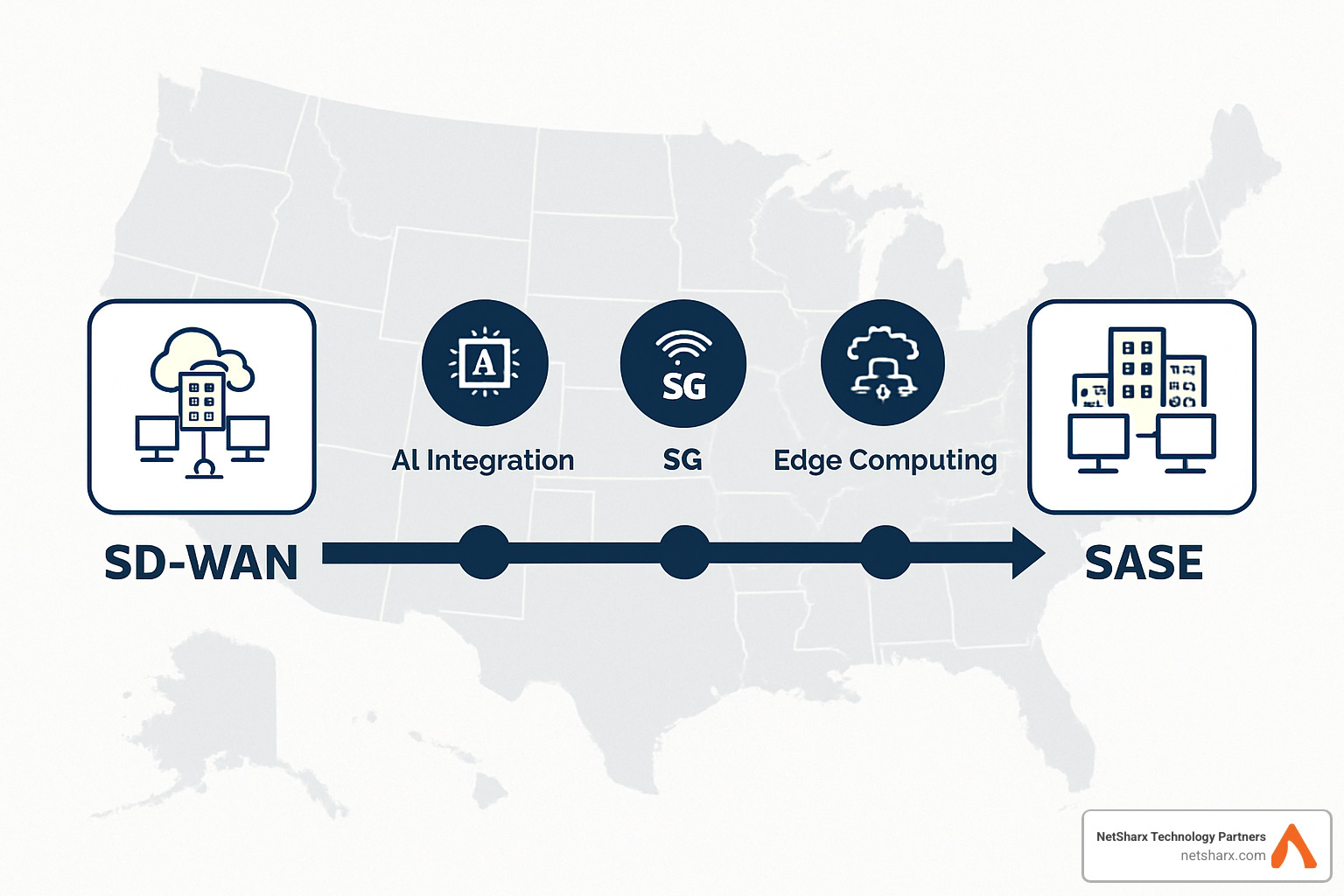
Evolution from SD-WAN to SASE
The path isn’t dramatic rip-and-replace but thoughtful convergence through incremental layering. Organizations layer new capabilities onto existing infrastructure, creating hybrid environments that preserve investments while adding value.
Brownfield migration strategies allow SD-WAN organizations to integrate SASE capabilities without disrupting operations – adding cloud-delivered security services to existing connections or implementing SASE remote access while maintaining branch connectivity.
Cloud & Digital Change Accelerator
Multicloud adoption has become the default enterprise strategy, creating complex networking challenges. SaaS performance directly impacts productivity when CRM, ERP, and collaboration tools are cloud-delivered. DevOps velocity requires infrastructure provisioned through APIs, enabling infrastructure-as-code approaches.
Compliance posture requirements demand consistent policy enforcement across all users, locations, and applications – easier with integrated platforms than point solutions.
How NetSharx Technology Partners Can Help
Our agnostic engineering approach means we design solutions for your organization, not sales targets. Our extensive provider network provides market visibility and better pricing terms. Competitive pricing focuses on total cost of ownership, and lifecycle support ensures ongoing value as requirements evolve.
For organizations ready to explore options, our Network Connectivity services provide comprehensive assessment and implementation support.
Frequently Asked Questions about SASE and SD-WAN
Does SASE require SD-WAN?
SASE doesn’t just require SD-WAN – it includes SD-WAN as a core building block. SASE SD WAN is like a Swiss Army knife with SD-WAN handling networking optimization while adding comprehensive security features.
If you have existing SD-WAN, you’re not starting from scratch. Many SASE providers can layer security services on top of current infrastructure, protecting your investment while adding capabilities.
Can SASE be implemented without replacing existing SD-WAN?
Absolutely, and this is often the smartest approach. Your existing SD-WAN infrastructure continues connecting branch offices while SASE services handle security. Branch-to-branch traffic flows through current SD-WAN, internet-bound traffic routes through SASE security services, and remote workers connect directly to SASE platforms.
This preserves infrastructure investment, reduces risk through gradual implementation, and maintains operational continuity during transition.
What key factors determine the right choice for my organization?
Workforce distribution: Remote/mobile workers favor SASE’s distributed user support; traditional offices may work well with SD-WAN.
Security requirements: Healthcare, finance, and government often need SASE’s integrated security approach.
Cloud strategy: Cloud-first organizations benefit from SASE’s optimized cloud connectivity.
Budget considerations: SD-WAN involves higher upfront costs but lower ongoing expenses; SASE uses predictable subscription models.
IT team expertise: SASE requires networking and security skills; SD-WAN focuses on networking.
Existing infrastructure: Recent SD-WAN investments favor layering SASE services; older MPLS infrastructure might justify direct SASE migration.
Conclusion
The journey from traditional MPLS to modern SASE SD WAN architectures represents reimagining how organizations connect, protect, and empower workforces in an increasingly digital world.
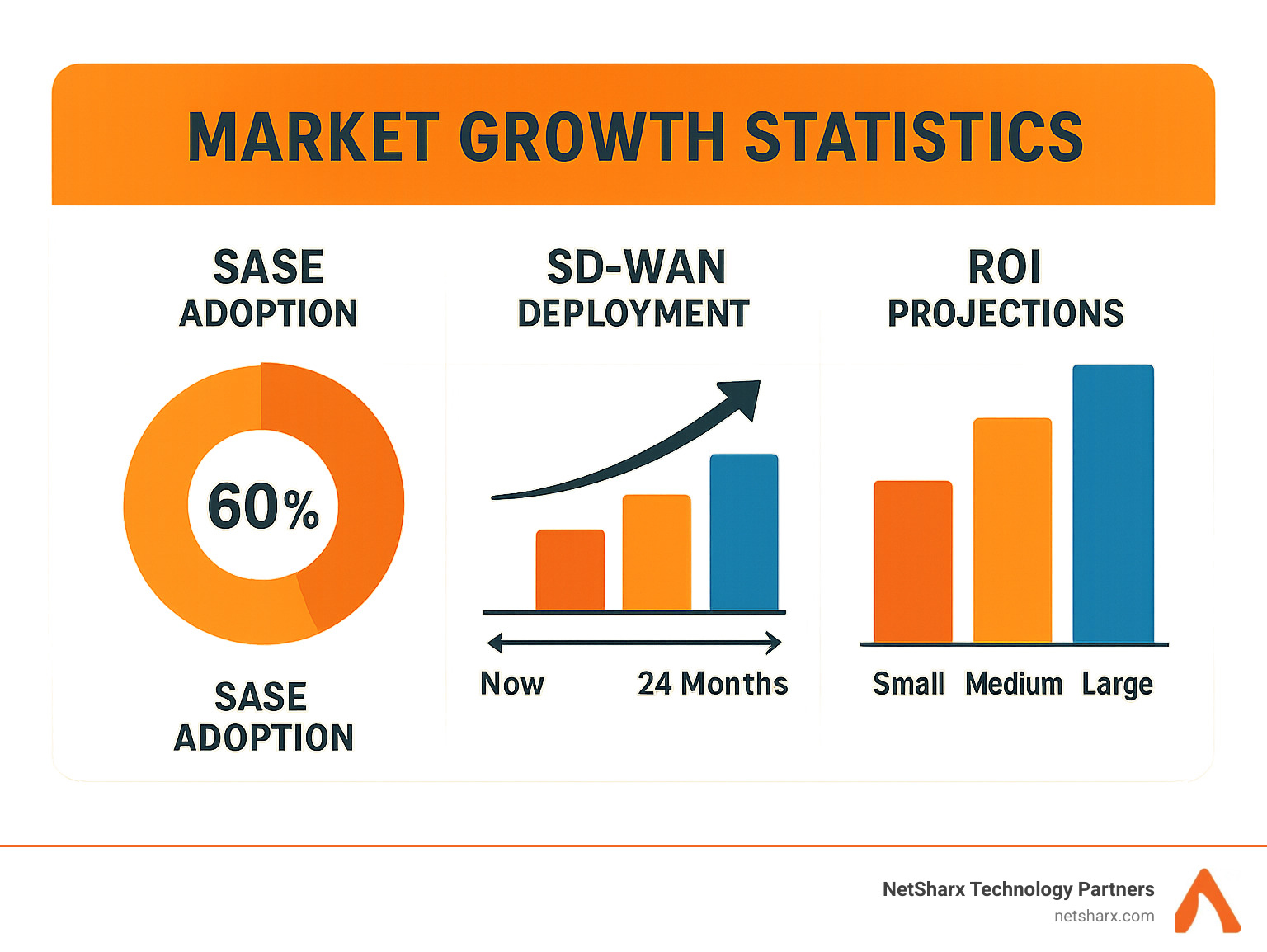
SD-WAN has proven itself with 95% of enterprises using or planning implementation within 24 months. The ability to cut WAN costs by 50% while improving performance delivers real value thousands of organizations experience daily.
SASE represents the next evolution – taking SD-WAN’s connectivity optimization and building security into the network’s fabric. With 65% of enterprises planning SASE adoption and the market projected to hit $11.29 billion by 2028, organizations recognize they need more than connectivity alone.
The key insight from our work is this isn’t an either/or decision. Successful organizations take thoughtful, phased approaches building on existing investments while adding new capabilities. They layer SASE security services onto existing SD-WAN, migrate remote users to cloud-delivered models, and gradually converge into unified architectures.
Future-proofing your network means building infrastructure capable of adapting to new cloud applications, evolving security threats, and regulatory changes. Security integration is becoming non-negotiable as distributed workforces and cloud applications make central data center inspection obsolete.
Your migration strategy should reflect your unique situation. Maybe you need SD-WAN’s immediate cost savings and performance improvements, with SASE security coming later. Or perhaps your remote workforce makes SASE the obvious choice. There’s no universal answer – only the right answer for your specific needs.
At NetSharx Technology Partners, successful SASE SD WAN implementations depend on understanding how technology fits your business strategy, operational model, and long-term vision. Our agnostic approach focuses on solutions that work for you, not vendor agendas.
The technology landscape will keep evolving, but organizations building networking foundations on modern SASE SD WAN architectures will be ready for whatever comes next.
For more information about our Network Connectivity services and how we can help you steer the transition to modern networking, contact us today. The future of enterprise networking is here – let us help you build the foundation your organization needs to thrive.
