
iPaaS for SaaS is changing how businesses integrate their cloud applications, heralding a new era in managing the complexities of cloud computing.
- Problem: As businesses rush to adopt cloud solutions, they’re stumbling over “cloud silos.” Different SaaS applications, like Salesforce or Amazon EC2, cause these silos because they don’t easily communicate with each other.
- Solution: An Integration Platform as a Service (iPaaS) breaks these silos, enabling seamless interactions between various software applications, whether cloud-based or on-premises.
Integration challenges arise as companies adopt more cloud services and find themselves juggling disparate systems. Recent shifts to cloud technologies have created an urgent need for smoother cross-platform integration. This complexity often overwhelms IT departments, but iPaaS offers a straightforward solution by acting as middleware that connects and automates processes across these applications.
I’m Ryan Carter, founder of NetSharx Technology Partners. With years of experience in enabling digital changes, I understand the problems businesses face in integrating SaaS solutions. My work focuses on delivering efficient and effective iPaaS for SaaS ecosystems, ensuring smooth operations and streamlined workflows.
Understanding iPaaS and SaaS
Let’s delve into iPaaS and SaaS, pivotal technologies in cloud computing that are reshaping business operations and system integrations.
What is SaaS?
Software as a Service (SaaS) delivers applications over the internet, allowing users to avoid the complexities of installation and maintenance. This model, where software is essentially rented rather than purchased, frees businesses from managing updates and hosting. SaaS solutions like Salesforce for customer relationship management and Box for data storage exemplify the convenience and scalability of this service model.
What is iPaaS?
Integration Platform as a Service (iPaaS) serves as the connective tissue between disparate software applications, facilitating seamless communication whether they are hosted on the cloud or on-premises. For instance, integrating a CRM system like Salesforce with an ERP system is made effortless with iPaaS, which automates data sharing and process synchronization.
The Role of Cloud Architecture
Cloud architecture, the framework supporting both SaaS and iPaaS, consists of three primary layers:
- SaaS: Directly delivers user-centric applications.
- Platform as a Service (PaaS): Provides a development environment for creating and integrating applications.
- Infrastructure as a Service (IaaS): Offers the essential virtual resources for deploying and managing operations.
This structured approach not only facilitates rapid scaling but also supports diverse service integrations, enabling businesses to swiftly adapt to evolving demands.
Why iPaaS Matters for SaaS
The proliferation of SaaS applications often leads to integration challenges, with iPaaS providing a crucial solution. By eliminating ‘cloud silos,’ iPaaS ensures that various applications can interact without barriers, enhancing overall system functionality and operational efficiency.
iPaaS for SaaS: Key Benefits
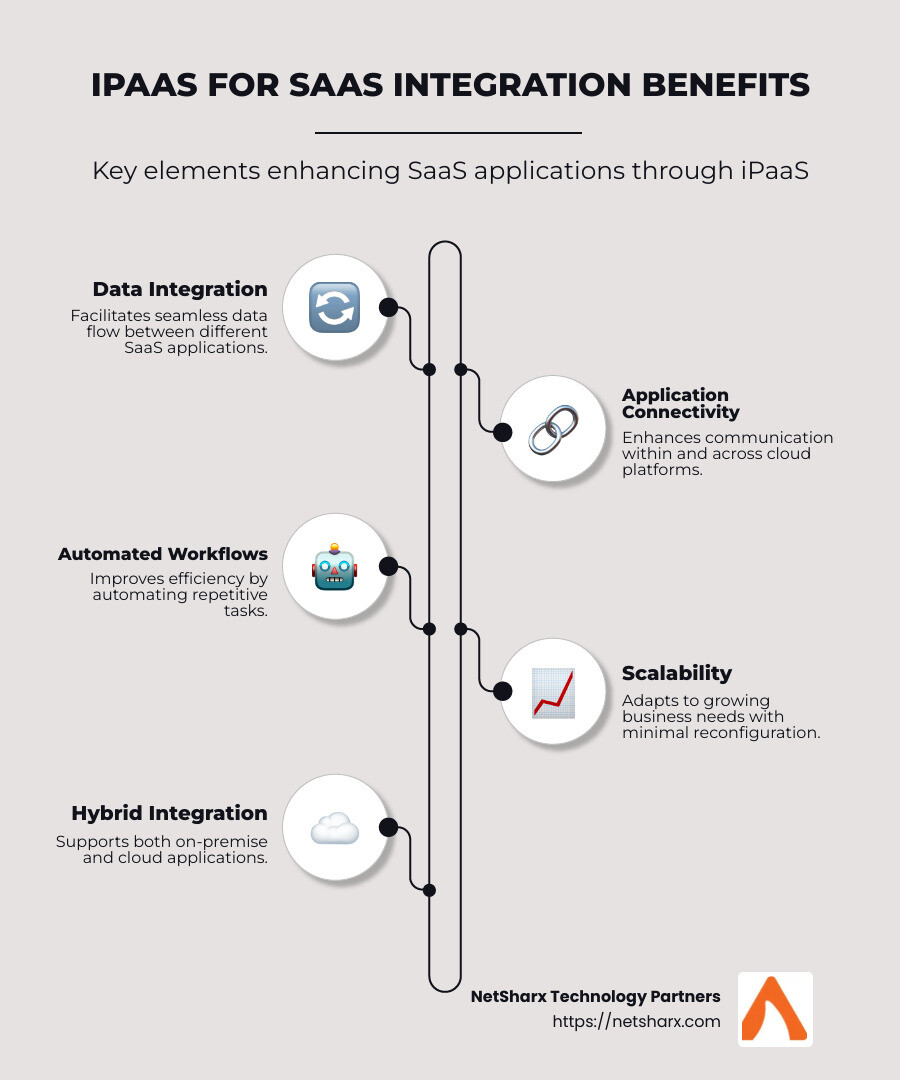
In the world of cloud computing, iPaaS for SaaS is a game-changer. It simplifies how businesses integrate and automate their software applications. Let’s explore the key benefits that make iPaaS essential for any SaaS-driven organization.
Data Integration
Data integration is at the heart of iPaaS. With multiple SaaS applications, businesses often struggle with data scattered across different platforms. iPaaS acts as a central hub, connecting these applications and ensuring data flows smoothly between them.
Imagine a company using Salesforce for customer management and QuickBooks for accounting. iPaaS enables these systems to exchange data effortlessly, keeping customer records and financial data in sync. This reduces manual data entry and minimizes errors, leading to more accurate business insights.
Application Integration
Beyond just data, iPaaS facilitates application integration. This means different software applications can work together as a cohesive unit. It’s like having a team where everyone knows their role and communicates effectively.
For example, a marketing team might use Mailchimp for email campaigns and HubSpot for CRM. With iPaaS, these applications can share information, ensuring that email lists and customer interactions are always up to date. This integration improves collaboration and streamlines workflows.
Automation
One of the standout benefits of iPaaS is automation. By automating routine tasks, businesses can save time and resources. iPaaS automates data transfers and processes between applications, reducing the need for manual intervention.
Consider a retail company using Shopify for e-commerce and an inventory management system. iPaaS can automate inventory updates, ensuring that stock levels are always accurate without manual checks. This not only speeds up operations but also improves customer satisfaction by preventing stockouts.
Improved Efficiency and Scalability
As businesses grow, so do their integration needs. iPaaS is designed to scale effortlessly, accommodating more data, users, and applications without extensive reconfiguration. This scalability is crucial for businesses looking to expand their SaaS ecosystem.
By centralizing management, iPaaS allows businesses to oversee all integrations from a single platform. This simplifies monitoring and control, making it easier to adapt to changing business requirements.
In summary, iPaaS for SaaS offers a streamlined approach to data and application integration, coupled with powerful automation capabilities. It’s the backbone that supports efficient, scalable, and seamless operations in the modern cloud landscape.
Next, let’s dig into how to choose the right iPaaS solution for your SaaS needs, focusing on connectors, hybrid integration, and scalability.
How to Choose the Right iPaaS for Your SaaS Needs
Selecting the right iPaaS for SaaS involves several key considerations. Let’s break it down into three main areas: connectors, hybrid integration, and scalability.
Connectors
Connectors are the lifelines of any iPaaS solution. They enable different applications to communicate by translating and transferring data between them. When choosing an iPaaS, ensure it supports a wide range of connectors for your existing and potential future applications.
A robust iPaaS platform should support all major API protocols like REST, SOAP, and GraphQL. It should also handle various file formats such as XML, JSON, and Parquet. This flexibility ensures that your iPaaS can seamlessly integrate with any application in your tech stack, whether it’s cloud-based or on-premises.
Hybrid Integration
In today’s diverse IT environments, hybrid integration is essential. Many businesses operate with a mix of cloud-based and on-premises applications. An effective iPaaS should bridge this gap, allowing data to flow smoothly between different environments.
iPaaS platforms that support hybrid integration offer greater flexibility and control. They allow businesses to leverage existing on-premises investments while integrating new cloud-based solutions. This capability ensures that your integration strategy remains adaptable and future-proof.
Scalability
Scalability is critical as your business evolves. The iPaaS you choose should be able to grow with your organization, accommodating increased data volumes and more complex integrations without requiring significant reconfiguration or additional resources.
Look for an iPaaS that offers a user-friendly interface, allowing both technical and non-technical users to create and manage integrations with ease. Platforms like SnapLogic empower users with drag-and-drop tools, enabling them to build integrations without extensive coding knowledge. This ease of use can significantly reduce the time and resources needed for integration projects.
Choosing the right iPaaS for SaaS involves finding a solution that offers comprehensive connectors, supports hybrid integration, and scales effortlessly with your business needs. By focusing on these areas, you can ensure a seamless integration experience that improves your SaaS applications’ functionality and efficiency.
Next, we’ll explore the top use cases for iPaaS in the SaaS landscape, including application integration, API management, and data governance.
Top Use Cases for iPaaS in SaaS
When it comes to iPaaS for SaaS, there are three standout use cases: application integration, API management, and data governance. Let’s explore each.
Application Integration
Application integration is all about connecting different software applications so they can work together seamlessly. In many organizations, teams use dozens of apps, creating a complex web of software. Imagine trying to manually connect all these apps; it would be a nightmare. Here’s where iPaaS shines.
iPaaS provides a cloud-based platform that allows different applications to communicate effortlessly. This means your CRM, marketing tools, and ERP can share data without a hitch. For example, if a customer makes a purchase, this information can automatically update in your CRM, financial software, and inventory system. No more data silos, just smooth, automated workflows.
API Management
APIs (Application Programming Interfaces) are like bridges that allow different software applications to talk to each other. Managing these bridges can be tricky, especially when you have a lot of them. That’s where iPaaS comes in.
With iPaaS, you can design, manage, and govern APIs at scale. This means you can create APIs that allow your SaaS applications to connect with other systems, whether they’re in the cloud or on-premises. It also helps in monitoring API usage, ensuring security, and maintaining performance. By streamlining API management, iPaaS makes it easier for businesses to expand their software ecosystems without getting tangled in technical complexities.
Data Governance
Data governance is all about ensuring your data is accurate, consistent, and secure. With so many applications in play, maintaining data integrity can be challenging. That’s where iPaaS steps in to help.
iPaaS platforms offer tools for data integration and management, ensuring that data is consistent across all applications. This is crucial for making informed business decisions. For example, if your sales team is looking at data from the CRM, while your finance team is using data from another source, discrepancies can lead to costly mistakes. iPaaS ensures everyone is on the same page with the same data.
By automating data flows and ensuring data quality, iPaaS helps organizations maintain data governance, reducing errors and boosting confidence in business analytics.
In summary, iPaaS for SaaS is a game-changer for application integration, API management, and data governance. It simplifies complex integrations, improves communication between apps, and ensures data integrity. Next, we’ll answer some frequently asked questions about iPaaS and SaaS, shedding light on their suitability and functionality.
Frequently Asked Questions about iPaaS and SaaS
What is iPaaS and SaaS?
iPaaS stands for Integration Platform as a Service. It’s a cloud-based solution that helps connect different applications, data, and processes. Think of it as a translator that allows your software tools to speak the same language. This is crucial for businesses that use multiple software applications and need them to work together seamlessly.
SaaS, or Software as a Service, is a way of delivering applications over the internet. Instead of installing and maintaining software, you access it online, which saves time and resources. Examples include email platforms, CRM systems, and project management tools. SaaS is popular because it offers flexibility, scalability, and cost savings.
Is iPaaS suitable for all SaaS applications?
Not every SaaS application needs iPaaS, but it can be a game-changer for many. Integration flexibility is a key advantage of iPaaS. It allows businesses to tailor integrations to fit their specific needs, whether they’re connecting cloud-based apps, on-premises systems, or a mix of both.
For companies using multiple SaaS applications, iPaaS can streamline operations by ensuring that all tools work together smoothly. This is especially beneficial for businesses with complex data flows or those that require real-time data exchange between different systems.
How does iPaaS improve SaaS functionality?
One of the standout features of iPaaS is workflow automation. By automating repetitive tasks, iPaaS reduces the need for manual data entry and minimizes human error. This not only saves time but also improves productivity.
Moreover, iPaaS excels in data exchange. It ensures that data is consistently and accurately shared between different applications. This means that when a customer updates their information in one system, all connected systems get updated automatically. This consistency is vital for making informed business decisions.
IPaaS for SaaS improves functionality by providing seamless integration, boosting efficiency, and ensuring data accuracy. This makes it an invaluable tool for businesses looking to optimize their software ecosystems.
Conclusion
At NetSharx Technology Partners, we understand that navigating the complex world of technology can be overwhelming. That’s why we focus on delivering custom solutions that simplify this journey. Our expertise in cloud, network, cybersecurity, and communications solutions allows us to help you integrate iPaaS for SaaS effectively, ensuring seamless connectivity across your business systems.
In today’s digital landscape, technology change is inevitable. Businesses must adapt quickly to stay competitive. With our agnostic approach and extensive provider network, we offer solutions that are not only customized to your specific needs but also adaptable to future changes. This ensures that your technology infrastructure remains robust and scalable.
Moreover, our commitment to transparency and long-term relationships means that you are not just getting a service provider, but a partner who is invested in your success. We work with you through every step of the integration process, from selection to implementation, ensuring that everything is on track and aligned with your business goals.
Ready to transform your technology landscape? Find how our custom solutions can help you integrate iPaaS and SaaS for success. Visit our cloud solutions page to learn more.
By choosing NetSharx, you are choosing a partner dedicated to simplifying technology change and driving your business forward.
