
AI in digital transformation 2025: Unlock Success
Why AI in Digital Change is Reshaping Business Success
AI in digital change is the strategic integration of artificial intelligence into business operations to fundamentally reimagine how organizations create value, serve customers, and compete. It’s not just about digitizing old processes; it’s about building a truly intelligent enterprise.
Quick Overview: AI in Digital Change
- Definition: Using AI to reimagine business models, not just digitize existing processes.
- Core Impact: Enables predictive insights, intelligent automation, and data-driven decision-making.
- Key Difference: Transforms organizations into “intelligent enterprises” versus traditional digitization.
- Economic Potential: AI could contribute up to $15.7 trillion to the global economy by 2030.
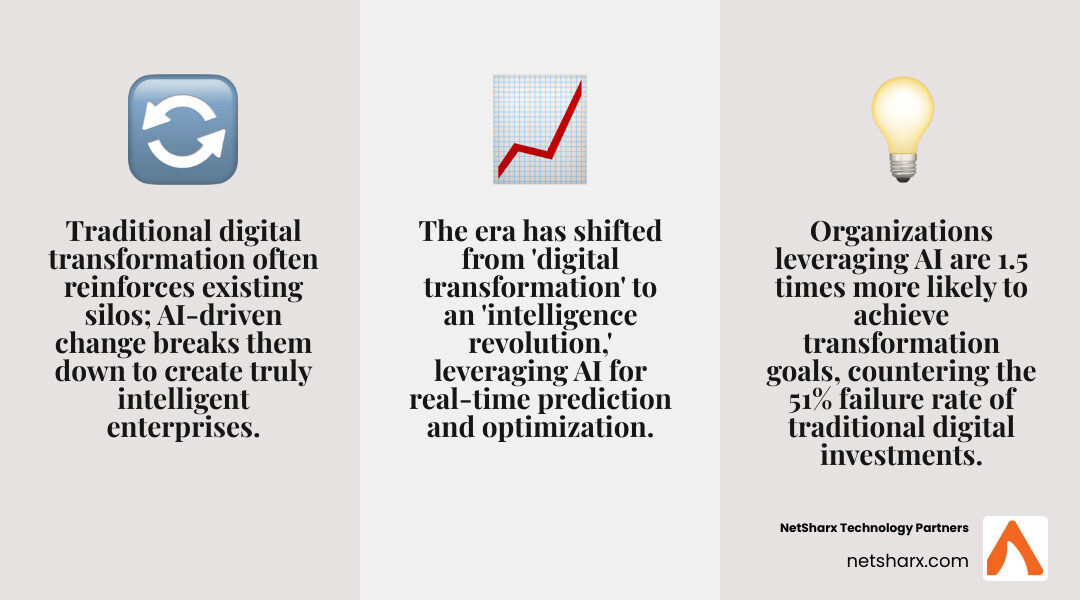
The numbers tell a stark story. While 85% of executives agree digital maturity is critical, many struggle to see returns on their investments. The game-changer is artificial intelligence, which is ushering in what experts call the “intelligence revolution.” Unlike traditional digitization that often reinforced existing silos, AI breaks them down, turning massive data sets into actionable insights and automating complex decisions.
I’m Ryan Carter, founder and CEO of NetSharx Technology Partners. Since 2022, we’ve helped organizations steer complex technology changes. I’ve seen how AI in digital change can reduce costs by 30% or more while accelerating project timelines from months to weeks. The question isn’t whether to adopt AI-driven change—it’s how quickly and effectively you can make it happen.
Simple AI in digital change glossary:
Beyond Digitization: How AI Fundamentally Reshapes Digital Change
For the past decade, “digital change” often meant putting a digital wrapper on analog processes—moving paper forms online or shifting file cabinets to the cloud. We were essentially making existing processes faster without fundamentally rethinking them. That era is over. Welcome to the “intelligence revolution.”
AI in digital change is different because AI can think, learn, and adapt. It doesn’t just execute commands; it makes intelligent decisions based on data patterns that humans might never spot. This shift is so profound that a PwC study on AI’s economic contribution projects it could add $15.7 trillion to the global economy by 2030. This value comes from a complete reimagining of business strategy, where data becomes your most valuable asset.
This revolution transforms business in three key ways:
1. From Process Automation to Intelligent Augmentation
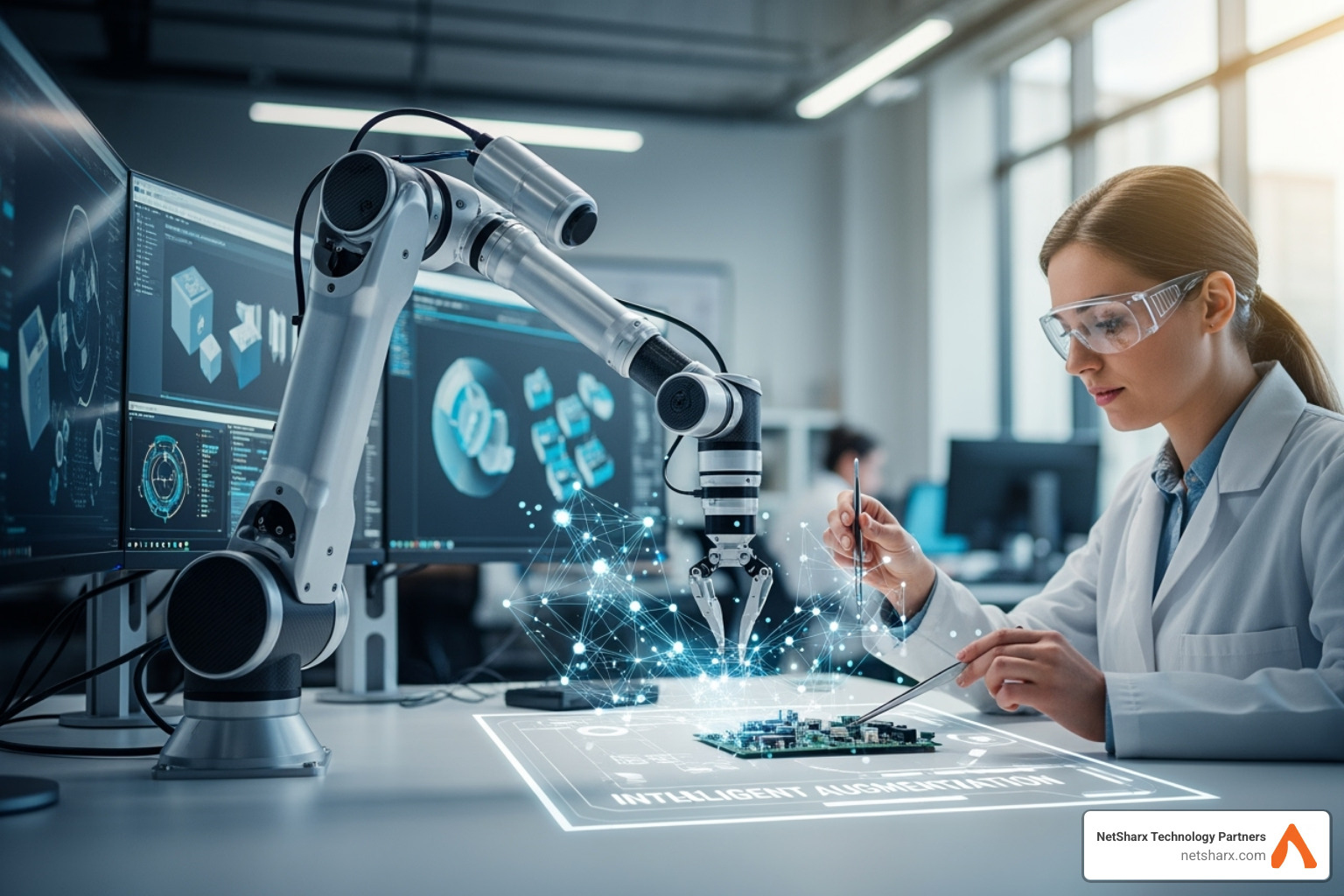
Traditional automation, like Robotic Process Automation (RPA), follows rigid “if-then” rules. AI takes this a step further with intelligent augmentation. Instead of just automating tasks, AI systems handle ambiguity, learn from experience, and augment human intelligence. An AI-powered chatbot can understand customer emotions and escalate issues with full context, empowering human agents to focus on complex problem-solving. This human-in-the-loop approach boosts productivity and reduces error by letting AI handle the data analysis while humans provide creativity and strategic thinking.
2. The Power of Predictive Insights
Where traditional business intelligence tells you what happened, AI tells you what’s likely to happen next. This is the power of predictive insights. Retailers can forecast demand with incredible precision, while other companies can predict customer churn and intervene proactively. In manufacturing, AI-powered proactive maintenance analyzes sensor data to predict equipment failure, reducing downtime by up to 30%. This shift from reactive to proactive decision-making is a core tenet of modern AI Driven Business Solutions.
3. Open uping Value from Unstructured Data
Most of your organization’s data—emails, social media comments, images, contracts—is unstructured, making it invisible to traditional analytics. AI is the key to open uping this “dark data.” Natural Language Processing (NLP) can analyze thousands of customer support tickets to spot trends, while Computer Vision can inspect products for defects on an assembly line. By analyzing all your data, not just the structured parts, you gain a complete picture of your business that was previously impossible to achieve.
Tangible Benefits and Applications of AI in Digital Change Across Industries
The promise of AI in digital change is delivering measurable results across every industry. Organizations that get AI right are 1.5 times more likely to achieve their change goals, often seeing cost reductions of over 20% while boosting profits. This isn’t about isolated gains; AI’s unique ability is to deliver improved efficiency, cost savings, deeper customer insights, and a sustainable competitive advantage all at once, creating a powerful flywheel effect for growth.
Revolutionizing the Customer Experience
AI is creating personalized, proactive customer relationships that were once the exclusive domain of luxury brands. Today’s AI-powered systems offer intelligent 24/7 support through advanced conversational AI that understands intent and context, handling complex queries and learning from each interaction. This can reduce customer service costs by 15-70% while improving first-contact resolution rates. The real game-changer, however, is hyper-personalization. By analyzing browsing history, purchase data, and real-time behavior, AI can create custom-built experiences, from dynamically adjusting a website’s content to offering predictive product recommendations that increase conversion rates and boost Customer Lifetime Value (CLV). Furthermore, sentiment analysis allows AI to understand how customers feel by analyzing text from reviews, support chats, and social media, enabling systems to proactively escalate issues or offer custom services at the perfect moment. Explore how to transform your customer relationships with AI Driven Customer Support and simplify your Customer Experience Change Simplified.
Optimizing Operations and Industrial Processes
Behind the scenes, AI is the engine of the next industrial revolution. In supply chain management, AI algorithms analyze vast datasets—including weather patterns, shipping lane congestion, and geopolitical risk—to create resilient and efficient logistics networks. This can cut shipping expenses by up to 50% through AI-powered route planning and reduce inventory carrying costs with hyper-accurate demand forecasting. In manufacturing, predictive maintenance is a prime example, with systems achieving up to 90% accuracy in predicting equipment failures, which can reduce downtime by 30%. Beyond maintenance, smart factories use AI-powered digital twins—virtual replicas of physical assets and processes—to simulate changes, optimize production lines, and improve quality control without disrupting real-world operations. This level of real-time optimization can boost overall manufacturing efficiency by 15% or more.
Bolstering Cybersecurity and Risk Management
As cyber threats grow in sophistication, AI has become an indispensable line of defense. Traditional security tools rely on signature-based detection to find known threats, leaving them vulnerable to new attacks. In contrast, AI security systems detect anomalies in real-time by establishing a baseline of normal network and user behavior. This approach, known as User and Entity Behavior Analytics (UEBA), can flag suspicious activities—like an employee accessing sensitive files at an unusual time—that would otherwise go unnoticed. This dramatically reduces threat detection and remediation times. In fraud prevention, AI’s pattern recognition power has helped financial institutions decrease fraud cases by 70%. Modern Security Orchestration, Automation, and Response (SOAR) platforms leverage AI to automate incident response, containing threats in seconds rather than hours. As a result, organizations with advanced security AI pay up to 80% less in data breach costs, making it an invaluable defense. Fortify your defenses with AI Based Cybersecurity Tools.
Changing Key Sectors: Finance and Healthcare
AI’s impact is especially profound in highly regulated and data-rich sectors like finance and healthcare. In finance, algorithmic trading processes market data at superhuman speeds, while AI-driven credit scoring uses alternative data sources to assess creditworthiness more fairly and inclusively. AI is also changing compliance, with RegTech solutions automating the monitoring of transactions for signs of money laundering (AML) and ensuring adherence to complex regulations. In healthcare, AI is accelerating drug findy, compressing development timelines from decades to years by predicting how molecules will behave. AI-powered diagnostic imaging analysis helps radiologists detect diseases like cancer with greater speed and accuracy. Beyond diagnostics, AI is enabling personalized medicine by analyzing a patient’s genetic data and lifestyle to recommend custom treatment plans. In hospitals, AI-driven resource management can optimize bed allocation and staff scheduling, reducing patient wait times by 30% and improving care delivery. For more on this, see our guide to AI Applications In Finance.
Navigating the Problems: Challenges and Ethical Considerations
While AI in digital change offers incredible opportunities, the path is paved with significant challenges requiring careful, proactive planning. Key problems include poor data quality, technical integration problems, the risk of algorithmic bias, high implementation costs, and a persistent talent gap. The International Monetary Fund has identified critical risks in Generative AI, yet only 20% of companies have risk policies in place, highlighting a dangerous gap between adoption and governance. Addressing these issues head-on is not just a matter of compliance but is crucial for building trust and ensuring the responsible, sustainable adoption of AI, a priority echoed in global initiatives like UNESCO’s work on AI ethics.
Technical and Implementation Barriers
Rolling out AI is far more complex than deploying standard software. Success hinges on overcoming several deeply technical problems:
- Data Quality and Governance: AI models live by the principle of “garbage in, garbage out.” Inconsistent, incomplete, or biased data will inevitably lead to flawed and unreliable AI systems. The process of data cleansing, labeling, and validation is resource-intensive, often consuming up to 80% of the time in an AI project. Establishing a robust data governance framework to ensure data quality and accessibility across the organization is a foundational, non-negotiable first step.
- Integration with Legacy Systems: Most established organizations run on a complex web of legacy systems. Making new, agile AI solutions work with these often decades-old, monolithic infrastructures is a major challenge. It requires extensive customization, sophisticated API strategies, and careful planning to avoid disrupting core business operations. The friction between fast-moving AI development and slow-moving legacy IT can stall projects indefinitely.
- Scalability and Cost: Pilot projects may be affordable, but scaling AI across an enterprise is a significant financial commitment. The costs are multifaceted and often underestimated, including massive computational power (specialized hardware like GPUs/TPUs), vast data storage, software licensing, and, crucially, the ongoing cost of model maintenance. AI models are not static; they require continuous monitoring for performance degradation or “model drift” and must be retrained periodically, creating a recurring operational expense.
- The Skills Gap: With 68% of companies reporting difficulty attracting AI talent, the competition for qualified professionals is a major bottleneck. The demand for specialized roles like Machine Learning Engineers, Data Scientists, and AI Ethicists far outstrips supply. This scarcity not only drives up costs but also slows down innovation, making talent acquisition and retention a key strategic battleground.
Our insights on Digital Change Best Practices can help you steer these complexities.
Ethical Dilemmas: Bias, Transparency, and Accountability

Ethical considerations are not abstract concerns; they have profound real-world consequences. Algorithmic bias is a primary danger, as AI trained on historical data can perpetuate and even amplify past societal discrimination. For example, a hiring algorithm trained on data from a historically male-dominated industry might unfairly penalize female candidates. This is compounded by the “black box” problem, where complex models like deep neural networks make decisions that are difficult for humans to understand, undermining trust and accountability. The field of Explainable AI (XAI) aims to address this by developing techniques to make AI decisions more interpretable, which is essential for debugging, ensuring fairness, and meeting regulatory requirements. Establishing clear accountability frameworks is critical to determine who is responsible—the developer, the user, or the organization—when an autonomous AI system makes a costly or harmful error. As NIST research on AI bias points out, combating bias requires a holistic socio-technical strategy that includes diverse development teams, rigorous testing, and continuous human oversight.
Data Privacy in the Age of AI
AI’s voracious appetite for data creates significant privacy risks that can erode customer trust and lead to severe penalties. Regulatory compliance with laws like GDPR in Europe and CCPA in California is non-negotiable, with the average cost of a data breach hitting $4.45 million in 2023. Organizations must secure sensitive training data throughout its lifecycle and use robust anonymization and encryption techniques. To mitigate these risks, pioneering techniques like federated learning allow models to be trained on decentralized data (e.g., on mobile devices) without the raw data ever leaving its source. Another method, differential privacy, involves adding statistical noise to data to protect individual identities while still allowing for aggregate analysis. The industry’s shift away from third-party cookies further emphasizes the need for transparent, first-party data strategies built on explicit user consent. Building customer trust through clear privacy policies and robust security practices is no longer just good practice—it’s a fundamental competitive advantage.
Building Your Foundation for AI-Driven Change
Starting on AI in digital change is like constructing a skyscraper: success depends entirely on the strength and depth of the foundation. Rushing into exciting pilot projects without proper groundwork is a common mistake that leads to wasted resources, failed initiatives, and skeptical stakeholders. A solid foundation for enterprise AI rests on five interconnected pillars: a clear strategic vision, committed leadership buy-in, modern infrastructure readiness, continuous talent development, and a deeply ingrained data-driven culture.
AI isn’t just another software implementation; it’s a fundamental business change that redefines how your organization operates, innovates, and competes. This requires intentional, methodical preparation. At NetSharx Technology Partners, our Digital Change Consulting services help you build this foundation systematically, ensuring your AI journey starts on solid ground and is built to last.
Assessing Your Organization’s AI Readiness
Before writing a single line of code, you need an honest, comprehensive assessment of your organization’s AI readiness—its holistic ability to deploy AI for measurable business value. This concept, sometimes called an organization’s “AIQ” (Artificial Intelligence Quotient), goes far beyond technology to include your data maturity, strategic alignment, culture, and people. A comprehensive study in Business Horizons provides frameworks for measuring this preparedness across four key dimensions:
- Data Readiness: Do you have high-quality, accessible, and relevant data to fuel AI models? This involves evaluating your data governance policies, data pipelines, and infrastructure like data lakes or warehouses that centralize information for analysis.
- Strategic Readiness: Is there a clear, C-suite-endorsed vision for how AI will drive specific business outcomes? This means moving beyond vague goals to define clear KPIs for AI projects, ensuring they are tightly aligned with core strategic priorities.
- People Readiness: Do you have the right talent, and is your broader workforce prepared to collaborate with AI? This includes assessing your current skills, identifying gaps, and establishing a plan for hiring, training, and change management. Creating an AI Center of Excellence (CoE) can help centralize expertise and drive best practices.
- Technology Readiness: Can your IT infrastructure support the demanding computational and data-handling requirements of AI? This involves evaluating your cloud capabilities, network bandwidth, security protocols for AI data, and MLOps (Machine Learning Operations) platforms for managing the AI lifecycle.
The Crucial Role of Cloud in the AI Ecosystem
For modern AI, cloud computing is the indispensable hero. Training sophisticated AI models requires massive, parallel processing power that is inefficient and prohibitively expensive to build and maintain on-premise. The cloud offers virtually unlimited, scalable computing power on-demand, allowing organizations to pay only for what they use. Beyond raw power, major managed AI/ML platforms from cloud vendors—like AWS SageMaker, Azure Machine Learning, and Google Cloud’s Vertex AI—democratize AI. These platforms bundle pre-built tools for every stage of the AI lifecycle, from data preparation and model training to one-click deployment and ongoing monitoring. This allows organizations to leverage sophisticated capabilities without needing a large team of deep in-house experts. The cloud also provides the secure, scalable data storage needed to house the massive datasets AI relies on, making it the essential foundation for any serious AI initiative. To learn more, explore our insights on Cloud Change and Digital Change And Cloud Computing.
Cultivating an AI-Savvy Workforce
Technology doesn’t transform organizations—people do. You can have the best AI tools in the world, but without a workforce equipped and empowered to use them, you’ll never realize their full potential. This is about more than just hiring a few data scientists; it’s about creating a pervasive culture of human-AI collaboration. Key steps include:
- Upskilling and Reskilling: Investing in internal talent development is a critical competitive differentiator. This means creating clear learning pathways to develop “citizen data scientists” (business users who can use AI tools to solve problems), AI product managers, and other hybrid roles that bridge the gap between business and technology.
- Fostering Data Literacy: Ensure everyone in the organization, not just specialists, understands the basics of how data is used to train AI and generate insights. A data-literate workforce is better equipped to identify opportunities for AI and to question its outputs critically.
- Promoting Human-AI Collaboration: Frame AI as a tool that augments human intelligence, not replaces it. Teach teams to work with AI, leveraging its analytical power to handle repetitive tasks while humans focus on strategic thinking, creativity, and empathy. For example, a financial advisor can use an AI tool to analyze market data and client portfolios, freeing them up to build stronger client relationships and provide more nuanced advice. By cultivating an AI-savvy workforce, you empower your people to drive the innovation that makes AI in digital change truly transformative.
The AI-First Mindset: Fostering a Culture of Intelligent Change
Successful digital change isn’t just about new technology; it’s about a new way of thinking. For AI in digital change, this means adopting an AI-first mindset, weaving intelligence into the fabric of how you plan and operate. It requires breaking down departmental walls, encouraging new ways of collaborating, and having leaders who champion the intelligence revolution. The cultural shift at Microsoft under Satya Nadella, where the company became cloud-first, is a powerful example of the deep change required. The goal is to create an environment where teams naturally ask, “How could AI help us solve this?”
From Siloed Functions to a Connected Enterprise
Many change efforts fail because departments optimize in isolation. AI in digital change provides the ability to connect these islands of activity into a single, intelligent system. When AI has access to data from across the organization, it can spot patterns no single department would ever see. This creates a “system of intelligence” that breaks down resistance by providing a common language of data and results. By creating a single source of truth, AI helps integrate decision-making, leading to faster, more adaptive ways of working that move the needle on strategic goals.
Leadership’s Role in Championing AI
AI in digital change lives or dies with leadership commitment. Effective AI leadership isn’t just about delegation; it’s about actively championing the change. This involves:
- Setting a Clear Vision: Paint a specific picture of how AI will deliver value, aligned directly with business goals.
- Securing Adequate Investment: AI requires significant resources for technology, talent, and change management. Leaders must champion this investment.
- Fostering Psychological Safety: Teams need to feel safe to experiment, learn from mistakes, and iterate quickly. As Gartner findings on board-level progress show, a lack of support for bold experimentation is a key reason why digital goals are not met.
Embracing a Culture of Experimentation and Agility
The breathtaking pace of AI innovation demands a culture of “intelligent experimentation.” Instead of betting on one massive initiative, successful organizations adopt an agile approach:
- Start Small with Pilot Projects: Launch focused experiments that can demonstrate value quickly.
- Adopt a Fail-Fast Mentality: When an experiment doesn’t work, the goal is to learn quickly, adjust, and iterate.
- Measure Success Holistically: Track not only financial ROI but also improvements in decision-making speed, customer insights, and organizational agility.
When you get this culture right, your organization becomes not just more efficient, but more adaptive and strategically impactful at every level.
The Future is Now: Emerging Trends and the Next Wave of Change
The journey of AI in digital change is accelerating, with emerging trends promising an even more profound wave of change. If current AI is like the first smartphone, what’s next is the entire mobile ecosystem. Technologies like quantum computing, advanced robotics, Edge AI, and the metaverse will converge to fundamentally reshape how we work and live, creating a world of interconnected, intelligent systems.

The Rise of Generative AI and Hyperautomation
Generative AI has burst onto the scene, not just recognizing patterns but creating new content—from code and marketing copy to new drug compounds. This is enabling hyperautomation: the automation of entire end-to-end business processes. For example, generative AI can analyze legacy systems, generate migration scripts, and perform automated testing, reducing complex projects that once took months to just weeks. This approach doesn’t just make work faster; it makes it more reliable by minimizing human error.
The Convergence of AI, IoT, and 5G
When AI is combined with the Internet of Things (IoT) and 5G networks, it gains eyes, ears, and lightning-fast reflexes in the physical world. This convergence creates interconnected ecosystems where billions of devices generate data that AI can process almost instantaneously. Smart factories can optimize production lines in real-time, and autonomous vehicles can make split-second decisions. 5G connectivity is the crucial ingredient, providing the ultra-fast, low-latency communication needed for these advanced applications. Preparing your infrastructure for this shift is critical, which is why understanding AI For Network Management is so important.
AI for Sustainability and Positive Impact
Perhaps the most inspiring aspect of AI in digital change is its potential to tackle humanity’s biggest challenges. AI is already making a real difference in optimizing energy grids to reduce waste and better integrate renewables. In sustainable supply chains, it identifies inefficiencies that reduce environmental impact while saving money. AI is also improving climate change modeling and is being used for social good, from personalized education platforms to coordinating disaster relief efforts. This demonstrates that AI is not just a business strategy but a pathway to a more efficient, equitable, and sustainable future. Learn more about how Digital Change And Sustainability can drive environmental responsibility.
Conclusion: Charting Your Course in the Intelligence Revolution
We’ve explored how AI in digital change is reshaping business, from its applications and challenges to the strategic foundation required for success. The core takeaway is this: we are moving beyond “doing digital” to “being intelligent.” This intelligence revolution isn’t about digitizing old workflows; it’s about reimagining how we operate, serve customers, and compete.
The path forward requires a holistic strategy that weaves together technology, data, people, and culture. It demands an AI-first mindset, the breakdown of organizational silos, and a culture of continuous experimentation. The future of work will be defined by human and artificial intelligence working together, where AI augments our abilities and empowers us to focus on creative, high-value strategic thinking.
Navigating this complex, rapidly evolving landscape can feel overwhelming. The technical complexities and strategic decisions can make even seasoned leaders feel uncertain about the best path forward.
That’s where we come in. At NetSharx Technology Partners, we understand that every organization’s journey is unique. We act as your trusted technology broker, offering completely unbiased expertise across cloud, network, cybersecurity, and communications. Our agnostic approach and extensive provider network ensure you get custom solutions that align perfectly with your strategic goals, helping you chart your course confidently through this intelligence revolution.
Ready to take the first step? Improving how your teams communicate and collaborate is often the best place to start.
Explore AI-Improved Communication Tools to begin your change and find how intelligent communication can be the foundation for your broader AI-driven change.
